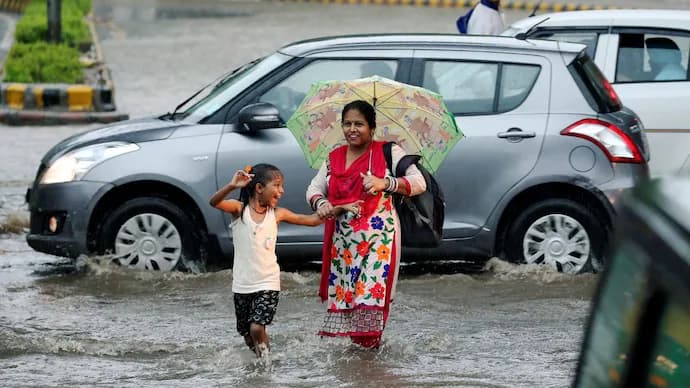
Just when Delhi residents were preparing for a punishing summer spell, the capital witnessed a dramatic weather reversal as sudden showers swept across parts of the city, bringing rare April relief and rewriting rainfall records.
The Palam Airport observatory recorded 19 mm of rainfall in the 24-hour period ending 8:30 am on April 18, marking the highest single-day April rainfall at the station in at least 14 years.

More than a passing shower, the unexpected downpour cooled roads, settled dust, and offered residents a welcome pause from rising temperatures. But meteorologists say the event was the result of an unusual clash between two powerful weather forces.
How did rain arrive in peak summer?
According to weather experts, the rainfall was triggered by a weak western disturbance interacting with strong local heat convection over Delhi.
A western disturbance is an extra-tropical weather system that forms over the Mediterranean region and typically brings winter rain and snowfall to northwestern India. By April, such systems usually weaken considerably.
This time, however, the disturbance carried enough upper-level moisture to create favorable conditions. What transformed that moisture into rain was Delhi’s intense daytime heating.
As the sun-baked surface warmed rapidly, hot air rose sharply from the ground in a process known as convection. That rising air lifted the available moisture higher into the atmosphere, where it cooled, condensed, and formed rain-bearing clouds.
In simple terms, the western disturbance supplied the moisture, while Delhi’s heat acted as the trigger.
Without the strong upward push created by local heating, the moisture may have passed over the city without producing significant rainfall.
Why was the rainfall largely confined to Delhi?
Experts said the event was highly localized because the rain developed where surface heating was strongest — over Delhi’s dense urban landscape.
This phenomenon is linked to the urban heat island effect, where cities become significantly warmer than surrounding rural areas due to concrete surfaces, asphalt roads, glass buildings, and reduced vegetation.
These structures absorb and retain heat more efficiently, creating pockets of higher temperatures that can intensify convection and spark thunderstorms.
Because the parent weather system was relatively weak and narrow, rainfall remained concentrated over sections of Delhi instead of spreading widely across the region.
Will the rain end Delhi’s summer heat?
Meteorologists caution that the relief is likely to be temporary.
With moisture clearing and skies turning sunny again, temperatures are expected to climb back toward 40°C from April 18 onward, signaling the return of Delhi’s familiar late-April heat.
Some humidity may linger briefly after the showers, but dry and harsher summer conditions are forecast to dominate in the coming days.
For residents, the message is clear: enjoy the cool spell while it lasts, because the capital’s summer furnace is preparing to switch back on.