Over 10,000 girls clear JEE Advanced for first time, set IIT record
Nearly 25% of female candidates clear exam as women’s success rate hits an all-time high since the introduction of supernumerary seats.
EPN Desk02 June 2026 05:24
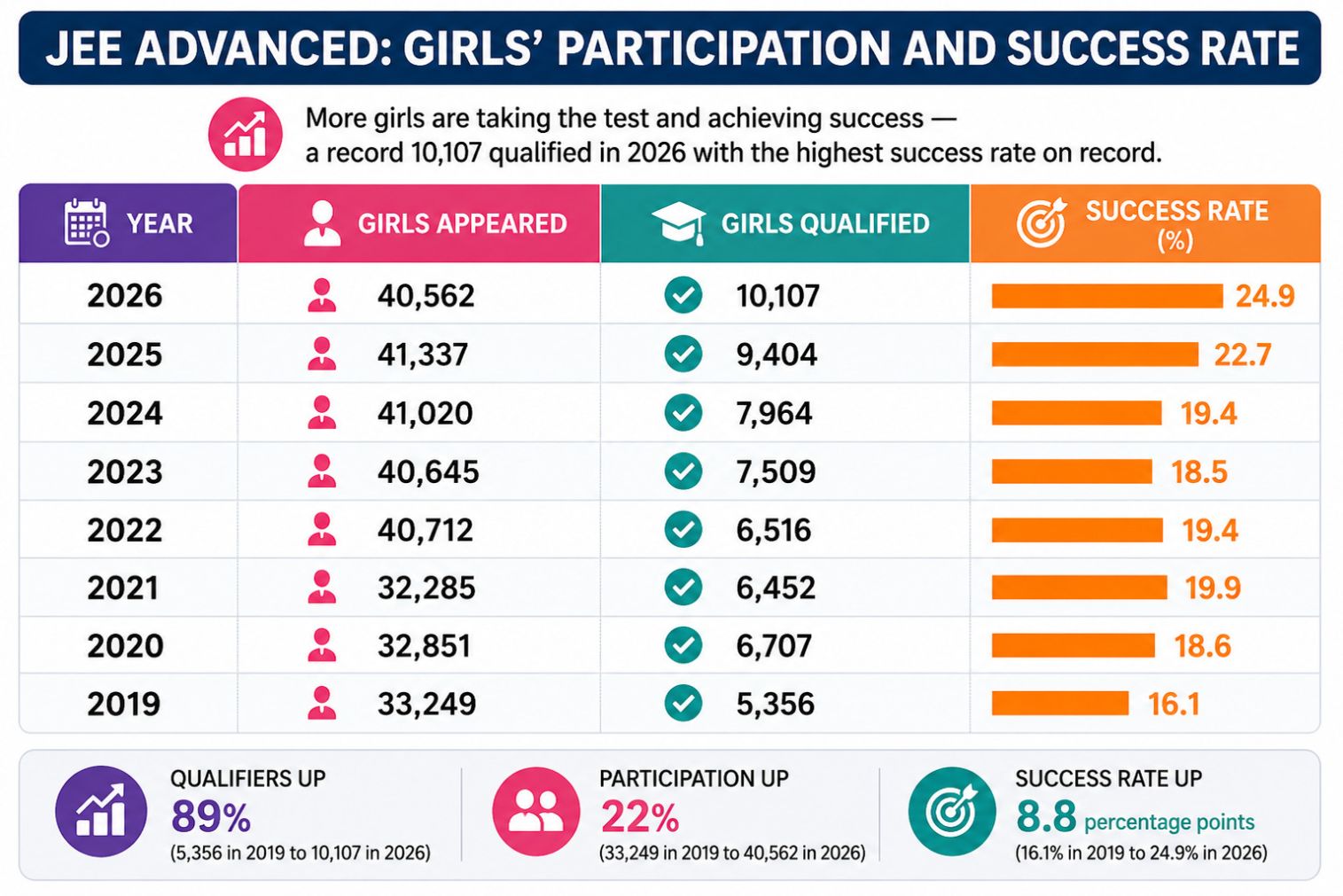
More than 10,000 girls have qualified for admission to the Indian Institutes of Technology (IITs) for the first time, with female candidates recording a historic 24.9% success rate in JEE Advanced 2026, the highest since the exam began.
Data shows that 10,107 girls qualified for the prestigious entrance examination this year, marking an increase of nearly 89% from 5,356 qualifiers in 2019. The rise comes in the wake of the supernumerary seats scheme introduced in 2018 to improve female representation across IIT campuses.
The number of women appearing for JEE Advanced has also grown steadily, rising by around 22% from 33,249 candidates in 2019 to 40,562 in 2026.
With the JEE Advanced 2026 results declared on June 1, nearly one in four female candidates cleared the examination. A total of 24.9% of women who appeared qualified, the highest pass rate recorded among female candidates so far. Overall, around 56,000 candidates made it to the Common Rank List.
Qualifying JEE Advanced does not automatically guarantee admission to an IIT, as the 23 IITs collectively offer around 20,000 seats. However, candidates who do not secure an IIT seat remain eligible for admission to other leading institutions, including National Institutes of Technology (NITs) and Indian Institutes of Information Technology (IIITs).
Education experts described the achievement as a significant milestone for women's participation in STEM fields, pointing to the impact of the supernumerary seats initiative. The scheme created additional seats exclusively for female candidates and aimed to raise women's enrolment in IITs to 20% within five years.
The progress has been notable. In 2018, only 13.47% of girls who appeared for JEE Advanced qualified. That figure has now climbed to nearly 25%.
Prof Shalabh of IIT Kanpur, who served as the organizing chairman of JEE Advanced 2018, said the achievement demonstrated that girls had surpassed the enrolment target set under the scheme and continued to prove their capability in highly competitive academic environments.
He noted that even candidates who do not ultimately secure IIT admissions are likely to join NITs and other premier institutions through their JEE scores, reflecting a broader shift in society where more families are encouraging girls to pursue careers of their choice.
Prof Deepankar Choudhury of IIT Bombay, former organising vice-chair of JEE Advanced and a founding member of the Joint Seat Allocation Authority (JoSAA), said the initiative had significantly strengthened gender diversity across IITs.
He also attributed the trend to the expanding academic landscape within engineering education. Over the years, IITs have introduced programmes in emerging fields such as Artificial Intelligence, Data Science, Biotechnology, Energy and Environment, alongside BS degrees in core sciences including Physics, Chemistry and Mathematics.
According to Choudhury, the wider range of academic options has made engineering and science education more appealing to a broader pool of students, including women.
Prof V Ramgopal Rao, former director of IIT Delhi and current Vice-Chancellor of BITS Pilani, said the scheme had generated a strong "peer effect", inspiring more girls to aspire to IIT admissions.
As increasing numbers of female students secure seats in IITs, awareness, confidence and participation among younger aspirants have also grown, creating a positive cycle that is reflected in the record-breaking results of JEE Advanced 2026.









.jpg&w=256&q=75)
