India’s first district-level PLFS data shows wide variation in youth NEET rates
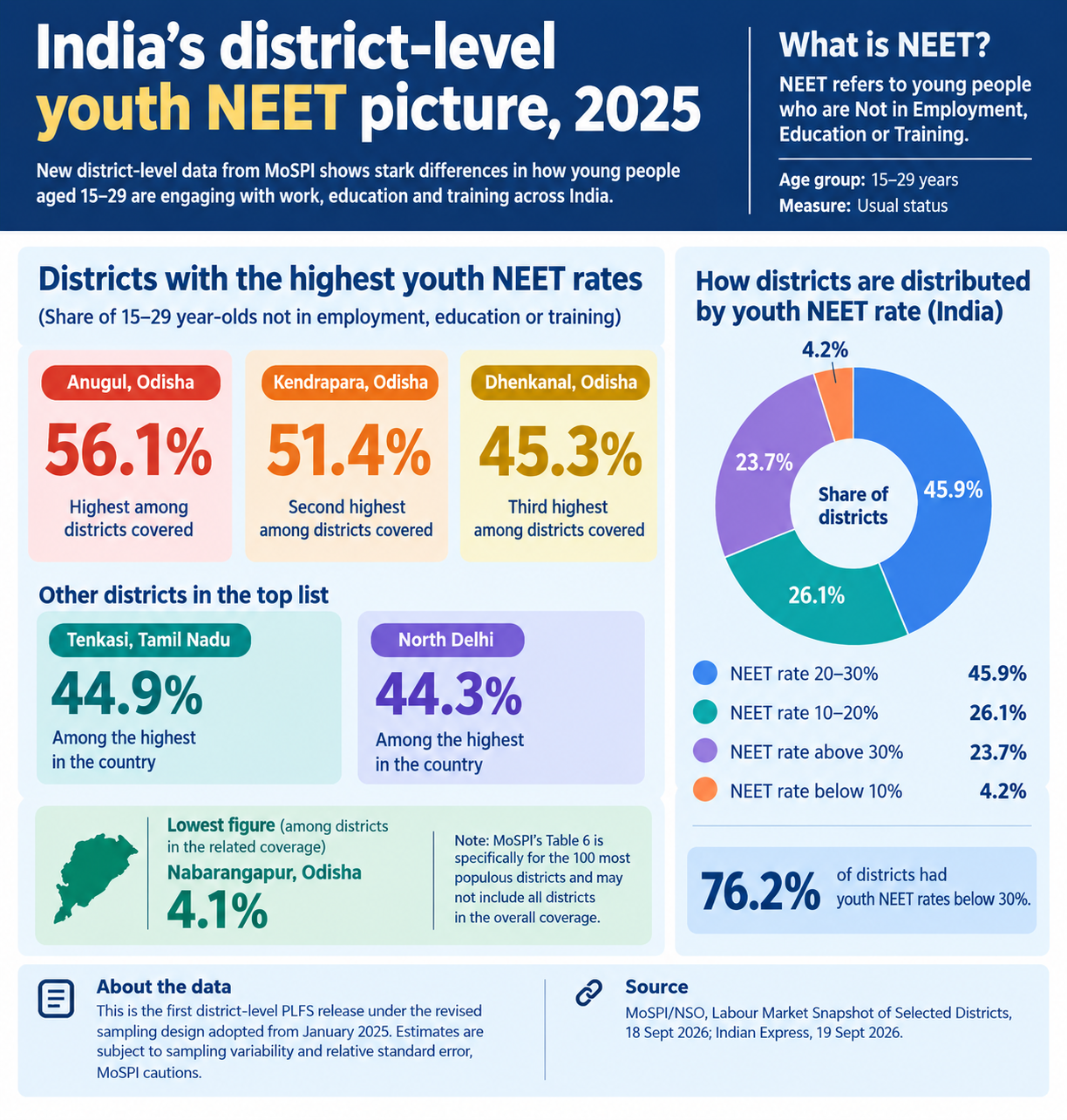
MoSPI’s 2025 PLFS estimates show that 23.7% of districts had youth NEET rates above 30%, while 45.9% recorded rates between 20% and 30%.
EPN Desk20 September 2026 07:25
India’s first district-level labour market estimates show wide differences in the share of young people who are outside employment, education or training, with nearly one-fourth of districts recording youth NEET rates above 30%.
The data was released by the Ministry of Statistics and Programme Implementation (MoSPI) on Sep 18 as part of its first district-level release under the revised Periodic Labour Force Survey (PLFS) sampling design.
The NEET indicator covers people aged 15 to 29 who were not in employment, education or training during the reference period. The estimates use the usual status approach, which considers activity during the preceding 365 days.
Nearly one-fourth of districts had NEET rates above 30%
MoSPI’s distribution of districts shows that 45.9% had youth NEET rates between 20% and 30%, making this the largest category.
Another 26.1% of districts recorded NEET rates between 10% and 20%, while 23.7% were above 30%. Only 4.2% of districts had rates below 10%.
Overall, 76.2% of districts had youth NEET rates below 30%, according to the official release.
The figures describe the proportion of young people who are simultaneously outside employment, education and training. NEET is therefore different from the unemployment rate, which measures unemployed people within the labour force.
Odisha districts stand out in broader district-level data
The district-level figures from the PLFS data show particularly high NEET rates in parts of Odisha.
Anugul recorded a youth NEET rate of 56.1%, the highest among the districts covered in the data. Kendrapara stood at 51.4%, while Dhenkanal recorded 45.3%. Tenkasi in Tamil Nadu recorded 44.9% and North Delhi 44.3%.
At the other end, Nabarangapur in Odisha recorded a NEET rate of 4.1%, the lowest reported among the districts in that broader dataset.
These district-specific figures should not be confused with MoSPI’s Table 6, which separately lists the 10 lowest NEET rates among the 100 most populous districts. In that restricted group, Ernakulam had the lowest rate at 9.6%, followed by Coimbatore at 14.5% and Bengaluru Urban at 15.0%.
What the first district-level release changes
The new release is significant because PLFS was redesigned from January 2025 to enable district-level estimates. Earlier, the survey’s sampling design was based on NSS regions and was not specifically designed to generate district-level estimates.
MoSPI said districts have now been used as the basic stratum for most of the geographical area, allowing labour market indicators to be produced at a more granular level.
The ministry has, however, cautioned against directly comparing these estimates with earlier NSS-region-based figures because the underlying survey design is different. It also advised users to account for sampling variability and relative standard errors when interpreting the estimates.
Other labour market indicators
The release also provides district-level estimates for labour force participation, worker population ratio and unemployment.
Among the 100 most populous districts, Surat recorded the highest labour force participation rate at 68.6%, followed by Araria at 68.0% and Salem at 67.8%. Surat also recorded the highest worker population ratio in this group at 67.8%.
For unemployment, South Twenty-Four Parganas and Araria recorded the lowest rates among the 100 most populous districts at 0.9%, while Ahmedabad stood at 1.1%.
The new district-level PLFS data therefore provides a more detailed picture of how employment, education and training participation varies across India, while MoSPI’s methodological caveats remain important when interpreting individual district estimates.