


Launched at IIIT-Bangalore, the 1,000-day initiative will mentor startups, researchers and engineers developing affordable connectivity solutions for rural and underserved communities through technical and entrepreneurial support.
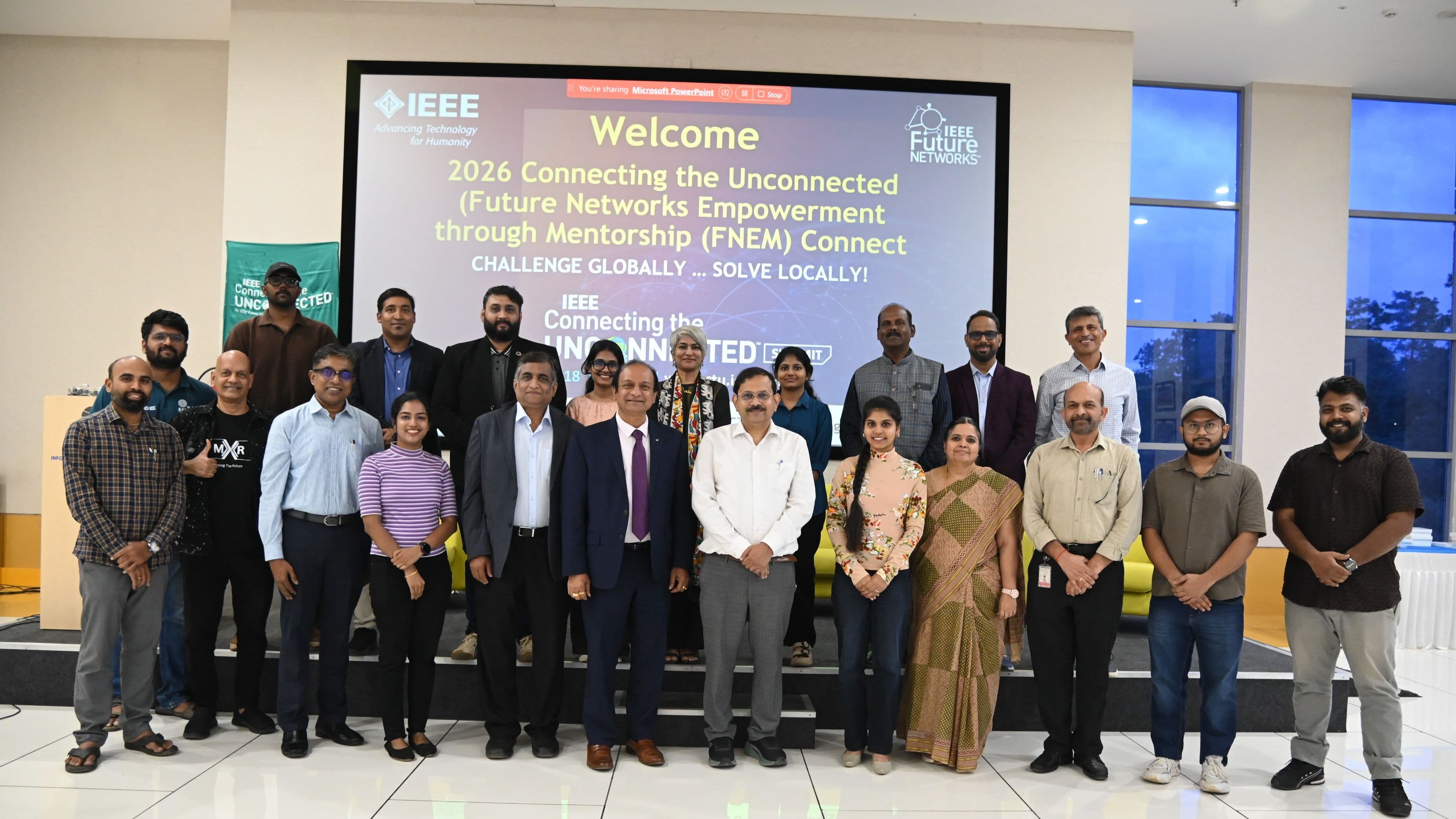
The Institute of Electrical and Electronics Engineers (IEEE) has launched its Future Networks Empowerment through Mentorship (FNEM) Powering CTU (Connecting the Unconnected) program in India to support innovators developing solutions for rural and underserved communities.
The initiative was launched at the International Institute of Information Technology Bangalore (IIIT-Bangalore), marking the start of its first cohort in India.

The program brings together early-stage technology innovators, startups, researchers and engineers working on solutions aimed at expanding affordable and sustainable connectivity.
IEEE said nearly half of the world's population, or about 3.7 billion people, still lacks meaningful internet access, with rural and underserved communities facing a disproportionate share of the connectivity gap.
The FNEM program seeks to address the challenge through long-term technical and entrepreneurial mentorship. Its 1,000-day LAMP journey, which stands for Learning, Action, Mentorship & Practice, will guide participants from developing initial concepts to proof-of-concept, validation, commercialization and sustainable business growth.
The India launch brought together researchers, startup founders, engineers, investors, standards specialists, industry representatives, faculty members and students. The event focused on collaboration and translating emerging technologies into solutions that can be deployed in communities with limited connectivity.
Dr. Ashutosh Dutta of Johns Hopkins University, Dr Sudhir Dixit of Basic Internet Foundation and Prof Ruolin Zhou of the University of Massachusetts Dartmouth, who co-chair the IEEE CTU program, outlined the initiative's focus on connecting young innovators with experienced mentors and technical experts.
Sharing the vision of the initiative, Prof Ashutosh Dutta Co-Chair of IEEE CTU said, “The IEEE CTU FNEM kick-off program at IIIT-Bangalore paved the way for implementing various award winning CTU technologies at the grass-root level to address the digital divide. This kick-off event was able to bring the mentors and mentees on the same platform to discuss the training materials and is the first step towards activating the LAMP programme supported by Lemelson Foundation and IEEE Foundation.”
Dr Sudhir Dixit Co-Chair of IEEE CTU highlighted the program's broader impact, stating, “The FNEM programme concluded at IIIT-Bangalore, inspired entrepreneurs through a daylong mentorship with experience, strategic guidance, and trusted networks, helping them transform innovative ideas into sustainable solutions that expand affordable Internet access, bridge the digital divide, and connect underserved communities worldwide. In a nutshell, this program will act as a catalyst to accelerate entrepreneurial success.”
Prof Ruolin Zhou Co-Chair of IEEE CTU emphasized the value of long-term mentorship, saying, “By pairing CTU innovators with experienced mentors at the FNEM kick-off event held at IIIT- Bangalore, the programme is helping transform promising ideas into practical and scalable solutions. Through this 1,000-day mentorship journey, we aim to empower innovators to develop sustainable technologies that expand connectivity, bridge the global digital divide, and connect the unconnected.”
The daylong event featured talks and a panel discussion involving industry experts on entrepreneurship, mentorship, intellectual property and IEEE rural broadband standards.
Participants were also introduced to five modules developed for the LAMP curriculum. The modules cover technological entrepreneurship, technology skills, business skills, community and user engagement, and local context and regulatory navigation.
The IEEE MOVE (Mobile Outreach Vehicle) Truck was also showcased at the event, reflecting the program's focus on rural connectivity and digital inclusion.
Dr Rakesh Kumar, Chair of IEEE Future Direction Committee, said, “As new technologies are developed it is important to demonstrate their feasibility and use to the community at large. Such outreach was demonstrated and very well received. I would like to thank the FNEM and CTU team for organizing this event.”
Dr Dilip Krishnaswamy, Executive Vice-president C-DOT Bangalore, highlighted the value of structured mentorship for deep-tech entrepreneurs and said, "Entrepreneurs working in areas related to social good use-cases such as CTU (Connecting the Unconnected) can be in different stages of development, such as in an idea gestation phase, or in an early-stage proof-of-concept phase, or in a relatively mature pilot phase of development."
Dr Debabrata Das, Director, IIIT-Bangalore, said, "IIIT-Bangalore is pleased to host the India launch of IEEE FNEM through Mentorship, an initiative that aligns closely with our commitment to research, innovation, and technology-driven societal impact for connect the unconnected (CTU) in rural areas."
Under the LAMP journey, participants will receive one-on-one guidance from IEEE technology experts and industry leaders while developing proof-of-concepts for rural connectivity and other engineering challenges.
The program will also cover technology commercialization, standards development, entrepreneurship, investment readiness and business strategy. The aim is to help participants turn technical concepts into scalable ventures with potential social and economic impact.
The first Indian cohort has received support from the Lemelson Foundation, which provides strategic backing for the global FNEM program. IIIT-Bangalore is serving as the academic and innovation partner for the India launch through its IEEE Student Branch Chapter.
The COMET Foundation at IIIT-Bangalore is contributing expertise in telecommunications research, deep-tech innovation and entrepreneurship. The IEEE Standards Association is supporting the program through its expertise in standards development.
The IEEE Bangalore Section and IEEE ComSoc Bangalore Chapter also served as technical partners, alongside several IEEE societies and organizations, including the IEEE Society on Social Implications of Technology, IEEE Reliability Society, IEEE System Council, IEEE Technology & Engineering Management Society, IEEE Entrepreneurship Bangalore Section, Johns Hopkins Whiting School of Engineering, IEEE Future Directions, IEEE MOVE, MTT-S, MXR, IEEE Antennas and Propagation Society, IEEE Education Society and IEEE 5G/6G Innovation Testbed.
The program's first India cohort was also supported by Ritu Srivastava, Program Manager for LAMP, Craig Polk, IEEE Project Manager, and Sandeep Agrawal, Scientist at C-DOT.
IEEE said FNEM Powering CTU is part of its broader effort to support technology development aimed at addressing social challenges.
The initiative seeks to help innovators create affordable and sustainable connectivity solutions while contributing to the goals of Digital India and the United Nations Sustainable Development Goals.
.jpeg&w=256&q=75)
South Korea tightens rules as AI enters exam cheating, Is India ready for next challenge?
.jpg&w=256&q=75)
Bangladesh looks to China for skills overhaul, from smart classrooms to graduate employment
.jpeg&w=256&q=75)
NMC mercy attempt: Eligible MBBS students get another chance to clear first professional exams
.jpg&w=256&q=75)
Global MBA without leaving work? IIM Kozhikode plans blended program for executives
.jpg&w=256&q=75)
IIT Madras School Connect sees girls close gender gap, account for 49% of enrollments
IIT Madras School Connect sees girls close gender gap, account for 49% of enrollments
.jpg&w=256&q=75)
Campus beyond caste: IIT Bombay issues new anti-discrimination guidelines

Study in Bengaluru, earn University of Liverpool degree: UK institution opens campus

4 dead in Oregon school shooting in US, teen gunman killed
_1.jpg&w=256&q=75)
If AI can solve business problems, why pursue an MBA? IIM Ahmedabad director explains

South Korea tightens rules as AI enters exam cheating, Is India ready for next challenge?
Bangladesh looks to China for skills overhaul, from smart classrooms to graduate employment
NMC mercy attempt: Eligible MBBS students get another chance to clear first professional exams
Global MBA without leaving work? IIM Kozhikode plans blended program for executives
IIT Madras School Connect sees girls close gender gap, account for 49% of enrollments
IIT Madras School Connect sees girls close gender gap, account for 49% of enrollments
Campus beyond caste: IIT Bombay issues new anti-discrimination guidelines
Study in Bengaluru, earn University of Liverpool degree: UK institution opens campus
4 dead in Oregon school shooting in US, teen gunman killed
If AI can solve business problems, why pursue an MBA? IIM Ahmedabad director explains
Copyright© educationpost.in 2026 All Rights Reserved.