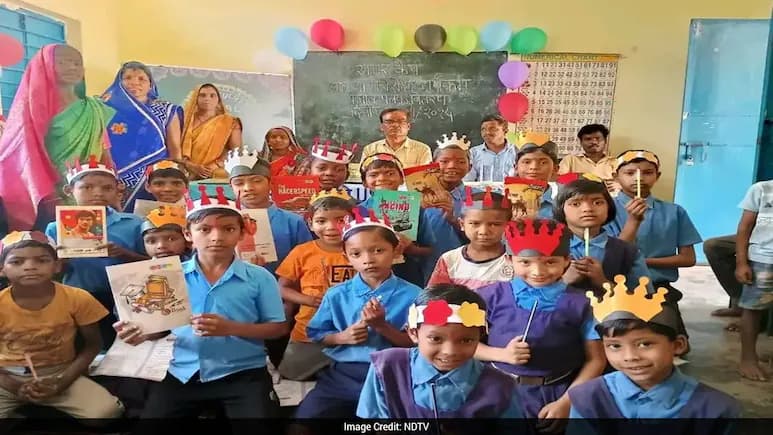
For many children entering Class 1, learning to recognise letters and read their first words can take time. But at Government Primary School Dakeipara in Chhattisgarh’s Korea district, teachers are using a simple approach rooted in children’s everyday experiences to make that transition easier.
The school says its Class 1 students are able to start reading Hindi within 15 to 20 days by learning through pictures, familiar objects and activities rather than being introduced to difficult textbook lessons straight away.

The idea is straightforward: begin with what children already know.
Teachers first introduce pictures of animals, plants and objects that children encounter in their homes and surroundings. These familiar images are then linked to letters and words. As children begin recognising the words associated with the pictures, they gradually move towards reading them independently.
The approach is based on a logographic reading method, which uses visual cues and familiar surroundings to help children make connections between objects, words and language.
Making language learning less intimidating
Teacher Arpana Mishra said an important objective in Class 1 is to build a strong foundation in Hindi and English.
Once children can read and understand a language, she said, they are better placed to engage with other subjects as well.
The school does not rely on a single teaching method for every child. Teachers adapt their approach according to the learning needs of individual students.
Education Saarthi Aanchal Kurre said children are encouraged to learn through games, dance and other activities. When a child finds it difficult to understand a lesson through the regular classroom approach, teachers use activities and alternative methods to make the concept easier to grasp.
The emphasis is on ensuring that children are not left behind simply because they learn at different speeds.
A planned academic calendar
The school also follows a structured academic schedule, with the annual syllabus targeted for completion by November.
Head teacher Rameshwar Prasad Singh said lessons, classroom activities and assessments are planned from the beginning of the academic session, allowing teachers to track students’ progress and provide additional support where required.
Students practise through textbooks, slates, notebooks and practice books. Children who require extra academic assistance attend an additional class for around an hour before the regular school day begins.
Learning beyond the classroom
At Dakeipara, education extends beyond reading, writing and textbooks. Students participate in painting, yoga, sports, gardening and other activities designed to make school a more engaging and interactive space.
The school has also created a link between its former and current students. Some former students who are now pursuing higher secondary education or college return as Education Saarthis, helping younger children with their studies and activities.
The school’s teaching practices and broader educational initiatives have earned it several district- and state-level honours. It has also received recognition from the Governor.
For the teachers at Dakeipara, however, the approach appears to be rooted in a simple classroom principle: when learning begins with something a child already knows and enjoys, the first steps towards reading can become less difficult — and more meaningful.