Government data presented in Parliament point to high toilet coverage in schools, but educators and activists say sanitation in government schools across India remains fragile due to the absence of sanctioned cleanliness workers.
During the Winter Session 2025, Tharaniventhan MS of the Dravida Munnetra Kazhagam asked for state- and union territory-wise details on functional and non-functional girls’ toilets in government schools.

In a written reply dated Dec 1, Minister of State for Education Jayant Chaudhary said that 94% of schools nationwide have fully functional girls’ toilets.
Official figures under the Samagra Shiksha Abhiyan show that Chandigarh, Delhi, and Goa have reported 100% construction coverage of girls’ toilets.
However, school administrators and researchers say the data do not address day-to-day maintenance or staffing responsibility, raising concerns about usability despite physical availability.
There is no comprehensive public dataset that tracks cleanliness workers in government schools.
Systems such as the Unified District Information System for Education Plus record infrastructure indicators including classrooms, toilets, and drinking water facilities, while surveys like the Annual Status of Education Report focus on learning outcomes and teacher availability. Non-teaching staff, including sanitation workers, are not systematically recorded.
National initiatives such as Swachh Bharat, Swachh Vidyalaya, and Samagra Shiksha require schools to meet water, sanitation, and hygiene standards, with emphasis on toilet construction, handwashing facilities, and regular cleaning.
However, these schemes do not formally mandate sanctioned cleanliness worker posts within school staffing norms.
In practice, sanitation work in government schools is handled through state or district arrangements, municipal bodies, or outsourced private agencies.
There is no centralized mechanism to monitor vacancies, appointments, or wages, resulting in inconsistent implementation across regions.
Field-based accounts from Jharkhand, Madhya Pradesh, and Maharashtra indicate that vacant sanitation roles often compel teachers, mid-day meal staff, and students to clean classrooms and toilets or leave facilities locked and unusable for long periods.
Advocate and Right to Education activist Ashok Agarwal said outsourcing has worsened the situation in several states. Citing cases from Delhi, he said municipal bodies contract private agencies that pay workers extremely low wages.
“Cleanliness workers are paid ₹24,000–₹25,000 annually, roughly ₹2,000 a month, excluding break months, with no job security or formal recognition. By the time the government’s allocation passes through middleman commissions or the agency overheads, the amount reaching the worker is often reduced to a pittance,” he said.
Ambiguity around responsibility is also reflected in official vacancy listings. A Haryana government portal in August 2024 advertised more than 1,000 safai karmachari posts under a local nigam, but none were explicitly identified as school-based positions.
The effects are visible at the school level. At the Panshet Model Cluster School in Pune’s Panshet district, there is no designated cleanliness worker.
Headmistress Shabana Khan said she has repeatedly cleaned classrooms herself or asked the mid-day meal cook to keep toilets usable.
Representatives of the Bharatiya Gram Vikas Sangh working in Maharashtra and Jharkhand said there are no formal state sanctions or budget allocations for cleanliness workers in government schools.
Ashok Gaikwad said many schools rely on volunteers or non-governmental organizations, with cleaners paid between ₹2,000 and ₹3,000 per month based on the number of toilets.
Gaikwad said official school staffing norms list positions such as principal, assistant teacher, lab attendant, and librarian but exclude sanitation workers.
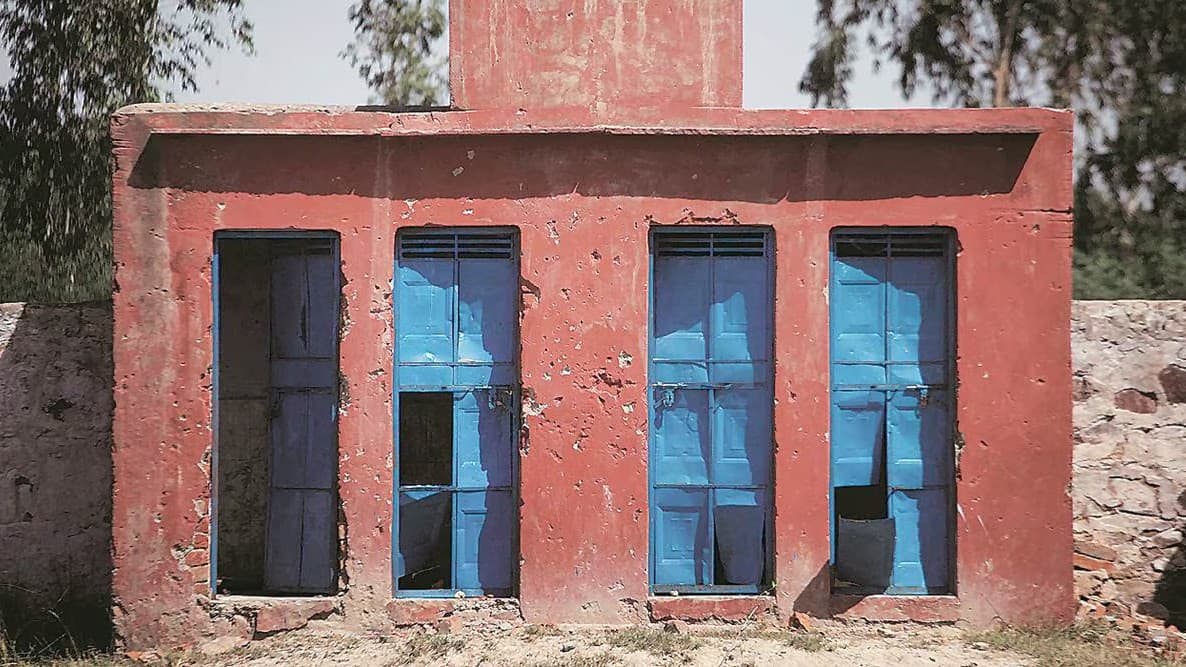
“Several schools do not have toilets within the campus, or they are locked or filthy. Teachers and students are forced to use nearby buildings,” he said.
He added that Corporate Social Responsibility funding is usually limited to one-time infrastructure support and cannot be used for salaries, water supply, or long-term maintenance.
In Jharkhand, Kashinath, who works closely with government schools, said cleanliness workers are “never thought of as a needful designation because they are treated as secondary within the education system.”
He said, “The focus has always been on infrastructure, teachers, quality education, rations, and other resources. Cleanliness workers were never seen as an essential part of a school.”
Despite infrastructure figures highlighted in Parliament, activists argue that legal requirements under the Right to Education Act extend beyond construction.
Agarwal said the law mandates separate toilets for boys and girls, adequate units based on enrollment, handwashing facilities, and running water.
“Literacy or foundational education standards cannot be met through construction alone, especially when schools and systems lack human resources,” he said.
Former National Commission for Protection of Child Rights chairperson Shanta Sinha said girls’ school dropout is rooted in social and economic factors rather than infrastructure alone.
She cited early marriage, domestic work, gender-based violence, early pregnancy, health issues, and restricted mobility.
“Education is seen as an escape from these conditions, and girls go to school despite these barriers, not because systems have made it easy for them,” she said.
While sanitation facilities are important for dignity, Sinha cautioned against treating infrastructure as the primary reason for girls’ enrollment or retention.
She said official datasets often fail to reflect ground realities and called for independent verification.
“If departments claim toilets are the reason girls attend school, that needs to be verified through surveys outside the system,” she said.
Sinha also said the practice of teachers and students cleaning school premises has become normalized and cannot be addressed through ad hoc measures by individual administrators.

She called for standardized recruitment and management of cleanliness workers and greater investment in human resources.
“This responsibility must lie with the education department,” she said, adding that sanitation cannot depend on voluntary or temporary arrangements.
“At the community and school level, every school has faced this, but who is listening?” she asked.





-1920x1080.jpg&w=256&q=75)