France student protests escalate as schools shut, teachers join demonstrations over funding and staffing
Students are demanding smaller classes, improved facilities, more teachers and better schedules, while the government faces pressure to address unrest without worsening its budget deficit.
Pragya Kumari06 October 2026 07:33
France is facing its biggest student protests in decades as hundreds of high schools remain closed or disrupted amid growing anger over overcrowded classrooms, teacher shortages, poor school infrastructure and inadequate education funding.
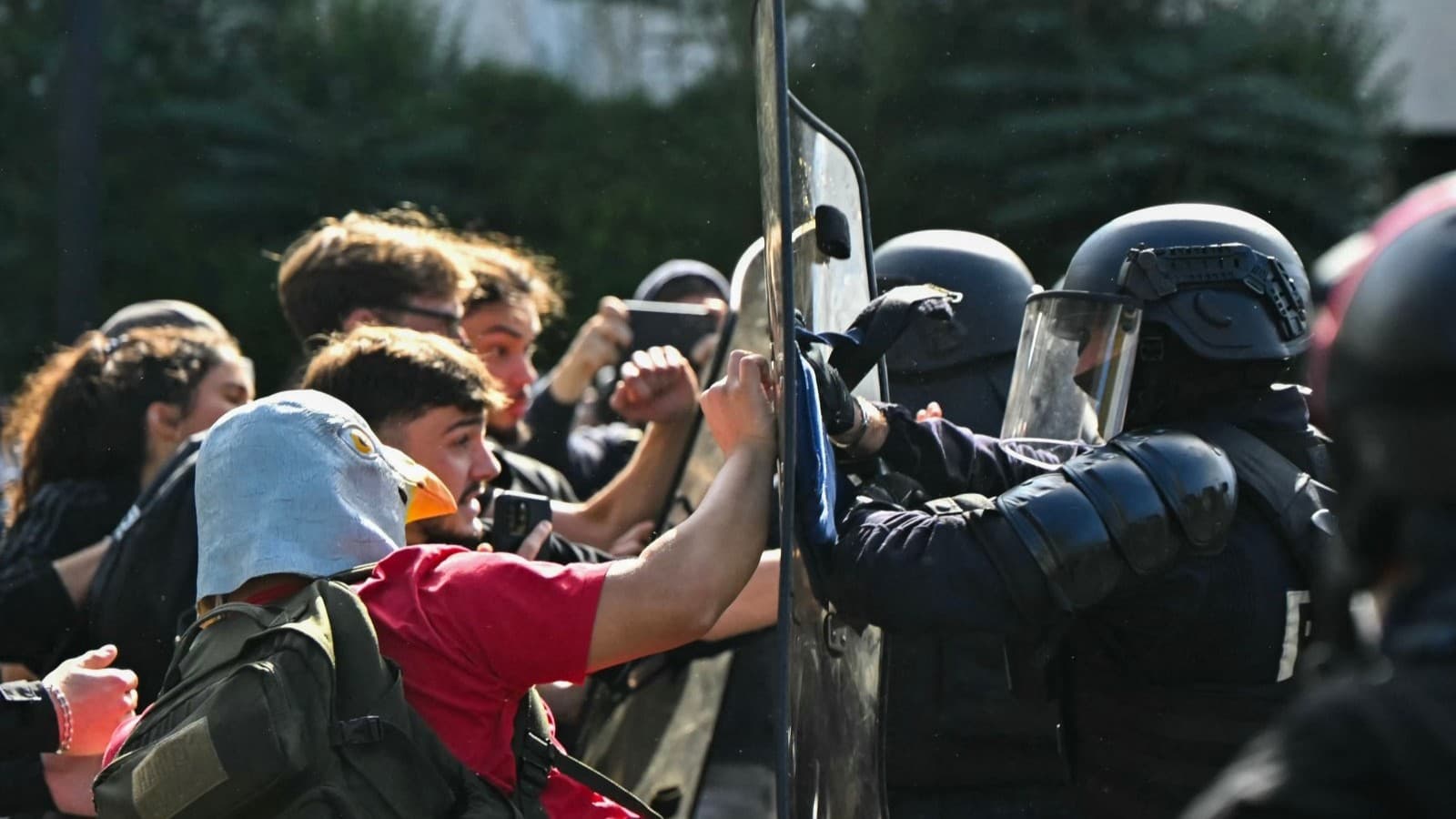
The protests, which began at a high school in the Paris region in September, have expanded nationwide, with students blockading school entrances and clashes with police reported in several cities.
Teachers' unions have also joined the movement, linking student demands to wider concerns over staffing, pay and public services.
About 400 of France's 3,700 high schools, known as lycées, were closed or disrupted on Oct 5, according to the Education Ministry.
The number of schools affected has continued to rise as students organize demonstrations and blockades across the country.
The protests are expected to intensify on Oct 6, when thousands of students, teachers and other public-sector workers are expected to take part in demonstrations across France. Major unions, including Unsa, CFDT and CGT have called on teachers to strike and join the student-led protests, with a major demonstration scheduled in Paris.
The movement began on Sept 21 at Saint-Exupéry High School in a Paris suburb, where students joined teachers in protesting staff shortages and a lack of resources. The school eventually received additional staff and the initial strike ended, but the protests quickly spread to other schools.
Student leader Manès Nadel described the rapid expansion of the movement as unprecedented.
“It’s an unprecedented number of schools that are now involved,” he said, adding that France’s Education Ministry had been “totally overwhelmed by the crisis.”
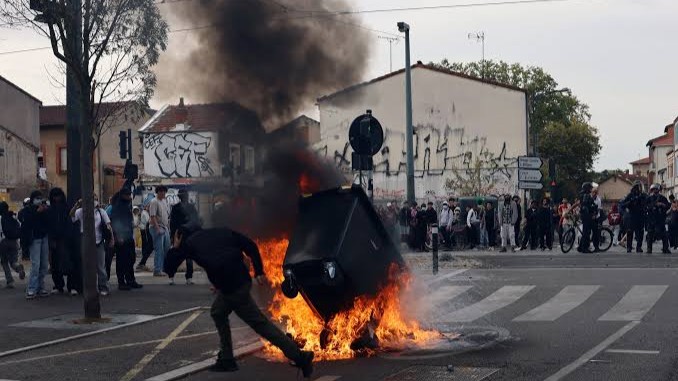
Students in Paris and surrounding areas began blocking school entrances before similar actions emerged in cities including Lille, Marseille, Bordeaux, Rennes, Nantes and Lyon. More than 100 high schools have reportedly been damaged since the movement began.
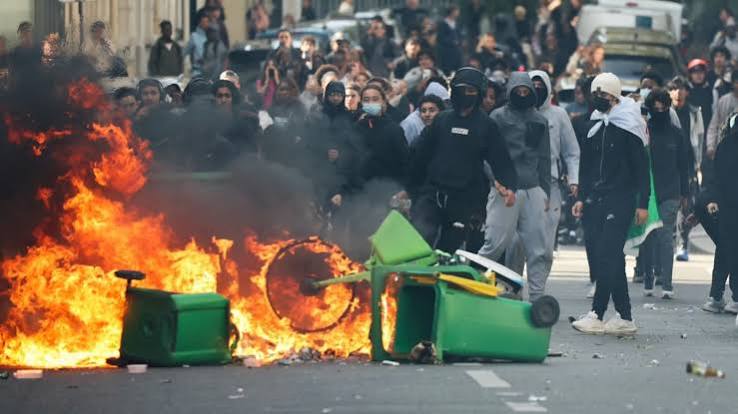
Some demonstrations have turned violent. Students have been accused of burning trash cans, erecting barricades and throwing bottles, paving stones and other objects at police.
Authorities said 48 law enforcement officers were injured during the unrest, while Interior Minister Laurent Nunez said hundreds of people had been detained during Tuesday's protests.
Nunez said 440 people had been detained nationwide, although the figure was not final, and about two-thirds were subsequently placed in police custody. He also said there had been seven incidents in which hydrochloric acid was thrown at police.
At the same time, police tactics have come under criticism. In Alençon, a police officer was filmed using a headlock on a girl, a technique that is now prohibited by law. In the Paris suburb of Seine-Saint-Denis, police carrying riot shields were reported to have struck students with batons.
The violence has also resulted in serious injuries among students. One student in Lens reportedly lost a hand after picking up a grenade, while another student in Tours reportedly lost an eye. Another student was reportedly struck in the head by a tear gas grenade.
Why are French students protesting?
Students are protesting conditions across the country's lycées, where pupils generally spend their final three years of secondary education between the ages of 15 and 18.
Their demands include smaller class sizes, more teachers, improved school buildings, better working and learning conditions, shorter and more manageable school schedules, and greater resources for schools.
At a school in Paris, students displayed a placard reading, “8am-6pm. More hours of lessons than sleep.” Other students have complained about classes with as many as 32 to 35 pupils and teachers being absent without replacement staff available.
Vincent Latour, a professor of British studies at Université Toulouse Jean Jaurès, said the grievances had been building for months, particularly after heatwaves exposed problems with school infrastructure.
“There has been discontent since successive heatwaves in June this year, which revealed the poor state of schools, with poor insulation and no air conditioning,” he said.
“The current wave is happening against a background of difficult conditions: missing teachers, teachers who are absent and not replaced, continued difficult material conditions, and discontent over working conditions and pay.”
The concerns also reflect longer-term pressure on France's secondary education system. A rise in the number of high school students following a fertility spike in 2010 has placed additional pressure on schools that have experienced years of funding reductions in real terms.
Secondary schools now have fewer teachers than in 2008 despite having about 250,000 more students enrolled. In the public sector, 70% of classrooms have more than 30 students, according to the information provided in the source material.
Students have also raised concerns about the condition of school buildings. Videos circulating for years have shown classrooms without enough desks or chairs, while pupils have sometimes had classes canceled when absent teachers could not be replaced.
In Saint-Denis, north of Paris, Mayor Bally Bagayoko joined hundreds of students outside Paul-Eluard High School and described their protest as “completely legitimate.” He said poorer areas received fewer resources than wealthier ones.
Latour said some students were also questioning government priorities, including its focus on restrictions such as the ban on wearing the abaya in state schools.
“Some students argue they should concentrate on what matters: offering pupils and students decent learning conditions,” he said.
Student protests coincide with public-sector strikes
The school protests have coincided with a nationwide public-sector strike over the government's proposed 2027 budget. The plan includes €54 billion in spending cuts and savings.
Teachers and students have found common ground in concerns about staffing shortages, crowded classrooms and deteriorating conditions.
Caroline Cheve, secretary-general of the FSU education union federation, said students and teachers were facing many of the same problems.
“They’re in overcrowded classrooms. Sometimes they don’t have enough teachers because of staffing shortages. They see the same reality as we do, and they’re angry,” she said.
The government also proposes freezing the base salaries of state employees in 2027, a measure expected to save about €2 billion. Unions say this would represent a fourth consecutive annual freeze.
Teachers, firefighters and other public-sector workers therefore joined Tuesday's action. The Education Ministry said just over 11% of teachers and other school staff participated.
Ryad Rani, president of the Union Syndicale Lyceenne, a high school students' union, called for nationwide school blockades alongside the public-sector strike while urging demonstrators to remain peaceful.
He said students were protesting a “general lack of resources," classes containing as many as 32 to 35 pupils, and shortages of teachers and other staff.
Rani also criticized instructions from the Interior and Education ministries calling for police to maintain order outside schools while using force proportionately.
“We’re talking about pupils of 15-18 years old and the government’s only response is automatic and institutionalised repression. It’s unacceptable,” he told BFM TV.
Government announces education measures
Prime Minister Sebastien Lecornu has sought to respond to the students' demands as the protests have grown.
In a letter dated Oct 4, Lecornu said the government was taking additional steps to address problems faced by high school students and education staff. He assigned ministers a roadmap covering five areas, with initial decisions expected before the end of October.
“These initiatives stem from issues raised by the academic councils on high school life, convened in recent days across all academies: they are the result of discussions with those who embrace dialogue and collaboration. This commitment must yield concrete outcomes,” the prime minister said.
The government's proposed areas of focus include ensuring classes are held, improving school facilities in partnership with regional councils, reorganizing school days, making Parcoursup more transparent and ensuring students' concerns receive follow-up.
Lecornu said the government would also need to address areas where funding remains inadequate during the parliamentary debate over the 2027 budget.
The government's initial budget proposal includes an additional €1.2 billion for National Education next year. Lecornu said the initial decisions, along with funding and implementation timelines, would be presented before the end of October.
“Dialogue must lead to visible changes in high schools,” he said.
However, the measures have failed to satisfy major student groups. The Union Syndicale Lyceenne said the government's response offered “nothing concrete,” while student leaders argued that the authorities had not adequately addressed the underlying problems.
Manès Nadel said the government's response had reinforced the reasons behind the protests.
“The government’s response has been irresponsible and it confirms exactly why the students are angry, because they are never heard,” he said. “They are responding only with repression.”
Government blames violence and political opponents
The government has drawn a distinction between peaceful student demonstrations and violent confrontations around schools.
Lecornu condemned violence and accused political opponents of encouraging an escalation.
“Fireworks, fires, violence near high schools: nothing justifies endangering students, staff or police,” he wrote on X.
Jean-Luc Melenchon, leader of the left-wing France Unbowed party, accused the government of ordering a crackdown on high school students.
“This brutality is irresponsible and has a clear racist undertone. Hands off our youth,” he wrote, calling on elected officials and party activists to intervene.
Lecornu described Melenchon's intervention as an “irresponsible escalation” and rejected the racism accusation as “an insult."
“Exploiting their anger for partisan purposes is wrong,” he wrote.
The government has also blamed the far left for involvement in the unrest. Officials have described some of the incidents as a shift from student demonstrations to “urban violence.”
About 5,000 people were arrested during the unrest last week, according to Interior Minister Laurent Nunez, with 85% of those arrested reportedly minors. In one day, about 2,000 people were taken into custody.
Lecornu has warned that the government “will not yield an inch to violence” while expressing support for injured students, school staff, police officers and gendarmes. He has also accelerated a review of the “casseur-payeur” bill, which would require those responsible for damage to pay for the consequences of their actions.
Pressure grows as France faces budget constraints
The government's ability to respond with additional spending is constrained by France's deteriorating public finances.
The protests have come as financial markets have increased scrutiny of France's budget deficit and political stability. The government is seeking parliamentary backing for a 2027 budget designed to reduce the deficit to about 5% of GDP, a target it failed to meet this year.
France's 10-year bond yield briefly exceeded 5% last week, its highest level since 2002, as political unrest added to concerns about the country's fiscal position.
The government is therefore attempting to restrain public spending while facing pressure from students, teachers and other public-sector workers for greater investment.
The political challenge is complicated by a divided parliament. Opposition parties have previously helped topple two prime ministers over budget plans during the past two years, while the presidential election next spring is increasing competition among political parties.
Far-right leader Marine Le Pen, who leads polling for the first round of the presidential election, is scheduled to present her party's budget proposals and a longer-term plan for €125 billion in savings if elected.
Her National Rally has indicated that it is willing to cooperate on the 2027 finance bill but will not offer a “blank check,” lawmaker Jean-Philippe Tanguy said.
“We want to avoid the worst - an escalation of the bond market crisis,” he said on Europe 1 radio. “It’s obvious that censuring the government could contribute to the escalation and we don’t want that.”
Wider cost-of-living anger adds to unrest
The student movement has emerged alongside broader dissatisfaction over living costs, fuel prices and public services.
The country has faced a surge in fuel prices linked to global conflicts, while fishermen blockaded several ports in late September. Calls have also increased on social media for a revival of the Yellow Vest protests, the grassroots movement that began in 2018 and later developed into nationwide riots.
Another general protest day has been planned for Oct 17 by Melenchon's France Unbowed party. Five unions have also called for a nationwide strike on Nov 5 in support of higher pay, public services, jobs and industry.
The political consequences could extend beyond schools. Latour said the protests were unfolding against a broader backdrop of anger over public services, high fuel prices and pressure on household finances.
“The political climate is rather explosive because of the upcoming presidential election,” he said.
He also warned that the unrest could reach universities, where funding pressures have increased in recent years.
“There is potential for a series of protests in French universities, given the underfunding of French universities over the past few years,” he said.
“There was a deterioration over the last year, which seems set to continue.”
What happens next?
Tuesday's demonstrations are expected to provide a major test of the government's ability to contain the unrest while maintaining support for its budget plans.
The student movement has already expanded far beyond the original protest at a suburban Paris high school. What began as a demand for additional teachers and resources has developed into a nationwide campaign involving students, teachers' unions and public-sector workers.
An Odoxa poll for Le Figaro found that 62% of French people supported the student mobilization. At the same time, the government is under pressure to prevent further violence, repair damaged schools and respond to demands for better education conditions without undermining efforts to reduce the budget deficit.
The protests have also revived comparisons with France's historic student movements. The May 1968 student protests developed into the country's largest general strike, becoming a defining political moment.
The current protesters, however, say their demands are more basic. They are calling for schools with enough teachers, adequate facilities, manageable class sizes and conditions that allow students to learn effectively.
For now, the government's proposed €1.2 billion increase for National Education and its five-point roadmap have failed to end the demonstrations. Student leaders continue to demand concrete action, while officials insist that dialogue must result in visible changes and that violence will not be tolerated.