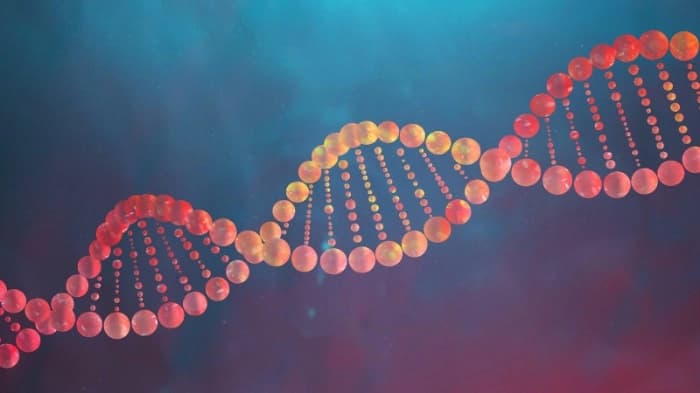
For humans and most other living things, deoxyribonucleic acid (DNA) is the genetic blueprint; DNA is found in almost every cell. Although a small amount is found in mitochondria as mitochondrial DNA, it is primarily found in the cell nucleus as nuclear DNA. Adenine (A), guanine (G), cytosine (C), and thymine (T) are the four chemical bases that make up DNA. These bases pair specifically (A with T and C with G) to form base pairs.
These bases form nucleotides that come together to form a double helix structure when they are joined to sugar and phosphate molecules. Similar to how letters combine to form words, the arrangement of these bases encodes the information required for the growth and upkeep of organisms. In order to ensure that newly formed cells retain the same DNA as the original, DNA must be able to replicate, creating exact copies of itself.

Identification and DNA
Like a fingerprint, DNA is a biological identifier that enables unique individual identification, much like an Aadhaar number does for social security. 46 DNA molecules, 23 from the mother and 23 from the father, are found inside chromosomes in every cell in the body. For example, 6.5% of the DNA is found in chromosome 3.
The technique known as Polymerase Chain Reaction (PCR) is used to amplify particular DNA sequences, even from very small DNA samples. To replicate the desired sequence, the process comprises separating the DNA strands, affixing primers to the target sequences, and using DNA polymerase. In about 50 minutes, millions of copies can be produced using this technique.
Uses for DNA Fingerprints
Applications for DNA fingerprints include matching organ donors, forensic science, paternity testing, and disaster victim identification. By locating suspects or exonerating wrongfully accused people, they can also help solve cold cases.
Relevance
Because DNA is so stable, researchers have been able to extract it from ancient human remains—some of which date back 65,000 years. Because of its stability, DNA is a valuable tool for utilizing archival materials to solve crimes.