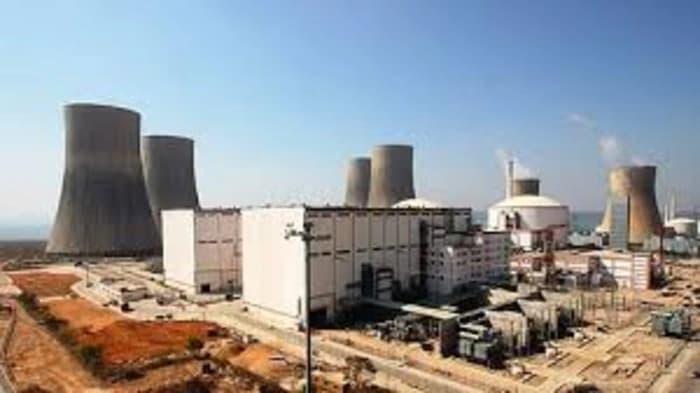
The announcement is part of a wider initiative to diversify India's energy mix, enhance regional energy security, and incorporate advanced technologies such as Small Modular Reactors (SMRs).
The Government has also sanctioned a project for 1,000 MW of battery storage capacity in Bihar, intended to improve grid stability and facilitate the integration of renewable energy.

The government will offer viability gap funding of Rs 18 lakh for every MW for this project.
What are Small Modular Reactors (SMRs)?
Small modular reactors (SMRs) are innovative nuclear reactors capable of producing up to 300 MW(e) per unit, which is approximately one-third the output of conventional nuclear power plants.
Compact – physically a fraction of the dimensions of a standard nuclear power reactor.
Modular – enabling systems and components to be pre-assembled in a factory and transported together to a site for installation.
Reactors – utilizing nuclear fission to produce heat for energy generation.
The four primary types of SMR are light water, high-temperature gas, liquid metal, and molten salt.
Benefits of SMR
Improved Safety Aspects: SMRs employ passive safety systems, like natural convection and gravity-based cooling, which assist in avoiding overheating without needing outside power or human involvement.
Flexibility: The modular design of SMRs enables gradual power increases, making it perfect for expanding energy demands.
Suitability for Remote and Off-Grid Locations: The compact design of SMRs allows them to be suitable for smaller grid setups and uses such as district heating and desalinating water.
Economical Building: Prefabrication in regulated settings shortens on-site building duration and expenses.
Government Programs to Strengthen India’s Nuclear Capability
India plans to boost its nuclear installed capacity from the current 8,180 MW to 22,480 MW by the year 2031–32.
The ongoing construction and commissioning of 10 reactors with a combined capacity of 8,000 MW is taking place in the states of Gujarat, Rajasthan, Tamil Nadu, Haryana, Karnataka, and Madhya Pradesh.
Global Partnership: Preliminary consent has been obtained for the establishment of 6 × 1,208 MW nuclear energy reactors in Kovvada, Andhra Pradesh, in collaboration with the United States.
Recent Advancements in Nuclear Energy in India
A major new uranium deposit was found near India's oldest uranium mine situated in Jaduguda (Jharkhand).
Rajasthan Atomic Power Project (RAPP-7) Attains Criticality: On September 19, 2024, RAPP's Unit-7 achieved criticality, marking an essential milestone in nuclear reactor functioning, signifying the commencement of a self-sustaining fission chain reaction.
This marks the third indigenous nuclear reactor to reach this level.
The Kakrapar Atomic Power Station Units 3 and 4, both rated at 700 MWe, began commercial operations in the fiscal year 2023–24.
These represent some of the earliest domestically conceived Pressurized Heavy Water Reactors (PHWRs) of this magnitude.
India's initial 500 MWe PFBR at Kalpakkam reached significant milestones in 2024, such as primary sodium filling, sodium pump commissioning, and core loading.