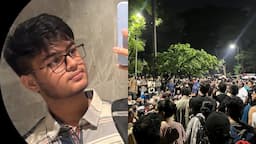
From asking citizens to inspect government schools to challenging education officials to send their own children to them, Cockroach Janta Party (CJP) founder Abhijeet Dipke is taking his “School Thik Karo” campaign beyond infrastructure and turning it into a question of accountability.
Speaking in Maharashtra’s Hingoli district, Dipke said children of education department officials should be made to study in government schools. He also called on ministers and politicians to send their children to village schools for at least a day so they could understand the difficulties faced by rural students.

The remarks came as the CJP stepped up its campaign to highlight problems in government schools, particularly in rural areas. Dipke had announced the nationwide campaign around Independence Day, asking parents and village leaders to inspect government schools and identify gaps in basic facilities.
The campaign's checklist includes basic requirements such as regular electricity, safe drinking water, separate functional toilets for boys and girls, and clean and nutritious mid-day meals. Citizens were also encouraged to document deficiencies through photographs and videos and report them through a form made available by the CJP.
Dipke's latest intervention shifts the emphasis from simply documenting shortcomings to questioning whether those responsible for running the public education system themselves rely on it.
He argued that education officials have a responsibility to ensure that government schools have adequate teachers and facilities, while their children often attend private schools. He said making officials' children study in government schools would lead to a major improvement in the system.
The CJP campaign has already produced local responses. In Rajasthan's Alwar district, CJP co-convenor Ashutosh Ranka joined a sit-in with primary school students demanding additional classrooms, clean toilets and drinking water. Local reports said officials accepted the demands.
In Maharashtra's Hingoli district, Dipke's campaign also focused attention on a Zilla Parishad school where he had highlighted deficiencies in basic facilities. Repair work subsequently began, while a computer was later provided to another government school in his native village of Santuk Pimpri after Dipke's visit there.
The campaign has also encountered resistance. The Rajasthan government issued restrictions on outsiders entering government schools and on taking photographs and videos, citing students' privacy. The order came after Ranka had announced visits by CJP volunteers to schools across the state.
The CJP's school campaign follows its earlier mobilisation around alleged irregularities in competitive examinations. The group had organised a 37-day sit-in in New Delhi, after which then Education Minister Dharmendra Pradhan resigned.
The group has now asked supporters who participated in the Delhi protests to take the campaign to government schools in their own areas.
The campaign has also taken a more contentious turn in West Bengal. Abdul Hafeez, who visited his former government school in Bankura district as part of the campaign, later alleged that BJP workers assaulted him and his father. His father died two days later. West Bengal Chief Minister Suvendu Adhikari said the alleged attackers were criminals with no BJP connection and assured action.
Despite the controversy surrounding that incident, Dipke has said the campaign will continue. The CJP's stated focus remains on basic school facilities, teacher attendance, safety, food and the wider functioning of government schools.
Dipke's latest challenge therefore puts a simple question at the centre of the campaign: if government schools are expected to be good enough for millions of children, are they good enough for the children of those responsible for running the education system?



.png&w=3840&q=75)