


Students at IIT Jodhpur explore Hindi as a teaching medium, easing their transition into technical education while balancing accessibility, academic performance, and the challenges of integrating regional languages in premier institutes.
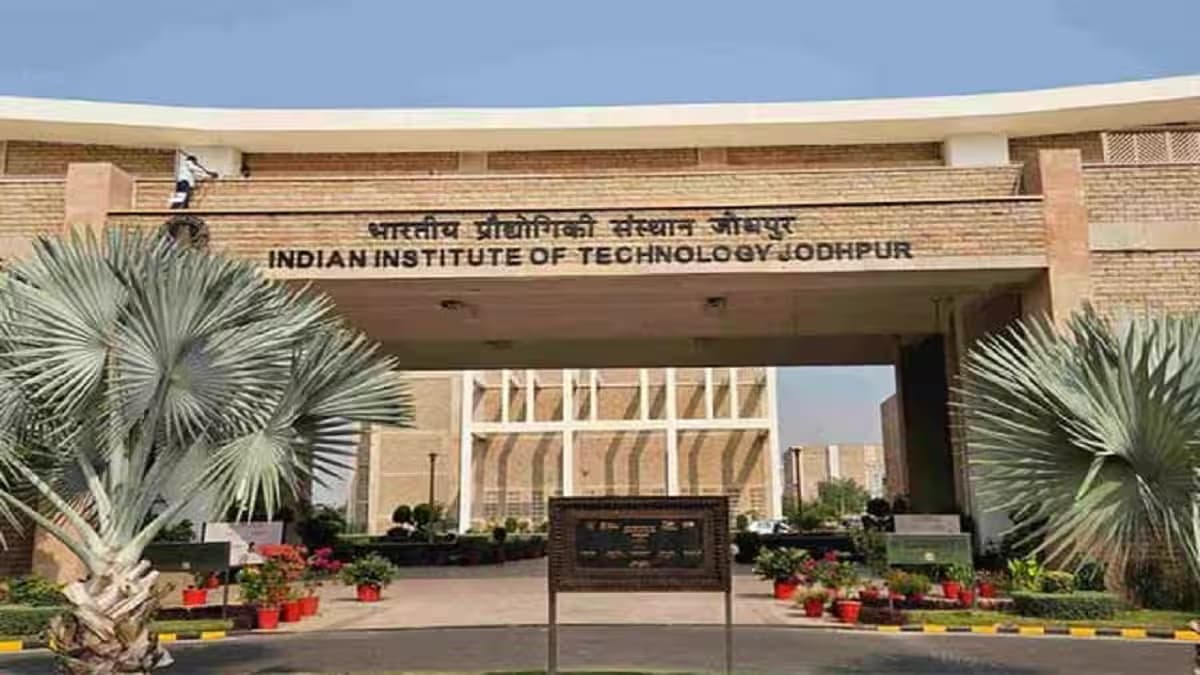
When IIT Jodhpur welcomed its latest batch of students last year, it introduced an option that set it apart from other IITs.
For the first time, first-year engineering students could attend lectures in Hindi instead of only English.

The move was particularly significant for students like Bhuvnesh Rajpurohit from Bilara in Jodhpur district. Initially, he joined English classes but quickly realized he was falling behind.
“At the orientation, when they told us we could attend classes in Hindi if we wanted to, I thought English-section students se peeche reh jaoonga,” he recalls. “Then I realized, agar yahan baitha toh peeche reh jaoonga.”
Having studied in the Hindi medium and cleared the JEE in the same language, he shifted to the Hindi section and completed his first year there.
Out of more than 500 students in his batch, 116 opted for the Hindi section during the first semester.
About half later moved back to English. Under the system, classroom discussions are in Hindi, while notes on the board, assignments, exams, and textbooks remain in English.
Faculty members conduct the same lectures for both groups to ensure parity, and students are free to switch between the two sections at any time.
The initiative reflects the emphasis on regional languages outlined in the National Education Policy 2020.
Union Education Minister Dharmendra Pradhan has encouraged IITs to adopt similar practices, but critics have pointed out challenges such as preparing teaching material, arranging additional faculty, and concerns over graduates’ employability.
For now, IIT Jodhpur is the only one of the 23 IITs to formally introduce such a system.
Director Avinash Kumar Agarwal says the approach is rooted in regional needs.
“We have to look at the language spoken within 500-700 km of the institute. This is the Hindi belt. It will make a lot of sense if each IIT picks up the local language,” Agarwal said.
“Of course, we should speak English to be connected to the international community. But to become a good engineer working in India, do you necessarily need an English education? The answer is no,” Agarwal added.
While the scheme is confined to the first year, many students say it gave them the confidence to gradually adapt to English-based study.
Sumit Kumar, a student from Aurangabad in Bihar, said, “I don’t want to remain restricted to Hindi. In the first year, I didn’t want my grades to be bad, so I attended classes in Hindi.”
“If you have studied in Hindi from the beginning, the answers are in your mind, but you can’t express yourself in English. The Hindi section helped with the transition,” Sumit added.
Faculty members acknowledge the added workload but also note its benefits. Assistant professor Palash Das, who teaches computer science, recalls his struggles when he studied in English despite coming from a Bengali-medium school.
Now he balances English-based teaching with Hindi explanations to help students grasp complex ideas.
Smaller class sizes in the Hindi sections have also made a difference. English sections often cross 200 students, while Hindi groups average around 50 to 60.
“Teachers are able to pay attention to us more closely, and it’s more interactive,” said Iftikhar Alam, a student of AI and data science.
Academic outcomes, too, show positive signs. According to Rajlaxmi Chouhan, associate professor of electrical engineering, students from Hindi backgrounds previously struggled to score well in the first year.
After the introduction of the Hindi section, however, their grades have improved significantly, with no major gap between English and Hindi sections except in computer science courses.
For Himanshu from Hisar, Haryana, the Hindi classes provided much-needed clarity.
“I couldn’t understand well because I had to convert what I heard into Hindi in my head and note it down. In a Hindi class, I can ask doubts in Hindi, without having to think about converting the question into English,” he said.
IIT Jodhpur’s Hindi section experiment has shown that regional language teaching can help students settle into the country’s top engineering institute, even as it raises questions about scalability and the balance between local accessibility and global competitiveness.
.webp&w=256&q=75)
Abu Dhabi aims to bring 2,000 Emirati teachers into private schools within five years

Budget Support to Strengthen Carbon Capture Research and Infrastructure
.jfif&w=256&q=75)
Trump Administration Retains Leverage Through Sanctions Act
New Questions on Digital Platform Employment from January
.jfif&w=256&q=75)
Husband’s Responsibility Does Not Extend to Married, Able-Bodied Brother
Abu Dhabi aims to bring 2,000 Emirati teachers into private schools within five years
.jpg&w=256&q=75)
Australian schools record thousands of student sexual misconduct reports as child safety concerns grow
.jpg&w=256&q=75)
Egypt insists international schools include Arabic, history in final scores
China’s Chery unveils AI companion robot designed to ease loneliness
.jpg&w=256&q=75)
New Zealand reforms could leave more students without school qualifications

Abu Dhabi aims to bring 2,000 Emirati teachers into private schools within five years
Budget Support to Strengthen Carbon Capture Research and Infrastructure
Trump Administration Retains Leverage Through Sanctions Act
New Questions on Digital Platform Employment from January
Husband’s Responsibility Does Not Extend to Married, Able-Bodied Brother
Abu Dhabi aims to bring 2,000 Emirati teachers into private schools within five years
Australian schools record thousands of student sexual misconduct reports as child safety concerns grow
Egypt insists international schools include Arabic, history in final scores
China’s Chery unveils AI companion robot designed to ease loneliness
New Zealand reforms could leave more students without school qualifications
Copyright© educationpost.in 2026 All Rights Reserved.