For 17-year-old Navya Tuteja, being unable to use ChatGPT at school did not push her away from artificial intelligence. Instead, it made her think more carefully about when AI is useful — and when it should be left aside.
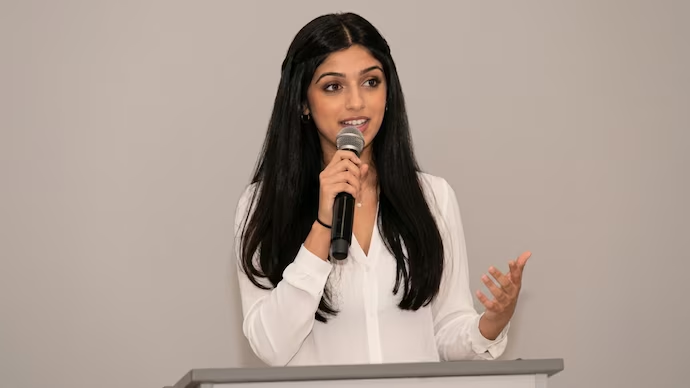
A senior at Thomas Jefferson High School for Science and Technology in Virginia, Tuteja has now built Raaha, a free AI-powered platform designed to help neurodivergent job seekers assess whether a job listing could be a suitable fit before they apply.

The platform has already attracted more than 1,000 users and 20,000 job listings within two months, according to Fortune.
Tuteja's interest in the problem is partly personal. Her mother is hard of hearing, and through her experiences, Tuteja began thinking about the barriers people with disabilities and other differences can encounter while navigating workplaces.
She also noticed a gap in conventional job advertisements. Listings typically describe what employers expect from candidates, but rarely explain what the day-to-day experience of working in that environment might actually be like.
Raaha aims to address that gap by assessing job listings across multiple factors, giving candidates additional information to consider before investing time and effort in an application.
A school without ChatGPT
At Thomas Jefferson High School, ChatGPT, Claude and similar AI tools are blocked on the school's Wi-Fi.
For Tuteja, the restriction initially meant using generative AI far less in her everyday schoolwork. But she now believes that experience helped her develop a more deliberate approach to the technology.
“It made me use it in school way less,” Tuteja was quoted as saying by Fortune. “So I guess, as annoying as it was, it was still good, in a way.”
Despite serving as president of her school's AI club, Tuteja says she deliberately keeps AI out of much of her own learning, particularly when studying for examinations.
She developed the underlying algorithm for Raaha herself, while using AI primarily for more routine tasks, including aspects of the website's design.
Her position on AI is therefore not simply one of embracing or rejecting the technology.
“I don’t think banning it is the solution,” she said. “I think you have to regulate it in the right way.”
From job listings to special education
Raaha is only one part of Tuteja's work with technology and accessibility.
She also created Legible, a tool that simplifies complex special-education documents, including Individualised Education Programs (IEPs) and 504 plans, making them easier for families to understand.
The project grew from another concern she identified with AI-generated summaries: simplifying information can sometimes make it harder for parents to trace claims back to their original sources.
In response, Tuteja developed a proposed transparency standard called Traceable Accessibility, which she has discussed with state lawmakers and the US Department of Education.
Her projects follow a consistent pattern — identify a problem, develop a practical solution and take it to the people who could use it or shape the rules around it.
Tuteja also runs Empower InvisAbilities, a student-led nonprofit that seeks to raise awareness about neurodiversity and invisible disabilities through workshops, educator resources and student chapters.
Keeping Raaha free for now
Tuteja has bootstrapped Raaha and currently offers the platform free of charge as she works to expand its user base.
A possible future business model could involve employers and workforce organisations paying to use the platform or improve their job listings.
For now, college remains part of her plans. But if Raaha continues to grow, Tuteja says she would consider putting college on hold to run the company full-time.
Her parents, Deepti and Rohit Tuteja, have also encouraged her to approach technology as a tool rather than a shortcut. Their message, she says, has been that AI can assist her work, but the thinking must remain her own.
That distinction sits at the heart of Tuteja's story.
A school restriction introduced to limit the use of generative AI became part of a broader lesson for her — that the challenge is not simply whether people should use AI, but whether they can learn to use it thoughtfully.
At 17, she is already testing that idea through a startup designed to make the world of work more accessible to others.






.avif&w=256&q=75)