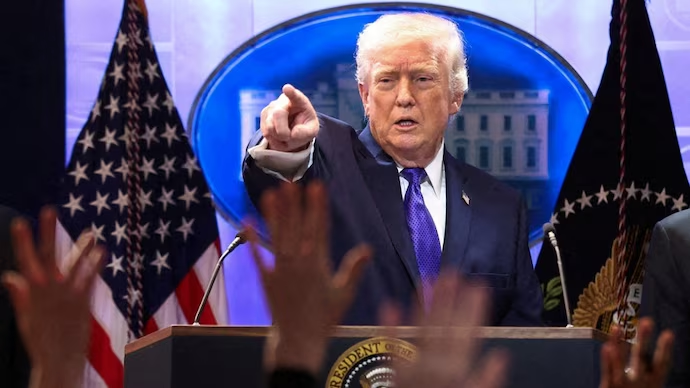
In a swift and defiant response to a judicial blow, US President Donald Trump on February 20 signed an executive order imposing a sweeping 10% tariff on imports from all countries, reaffirming that tariffs will remain central to his trade doctrine despite a Supreme Court setback.
The new levy, effective February 24 at 10:31 am IST, comes just hours after the Supreme Court of the United States struck down Trump’s earlier use of emergency powers to enforce broad import duties without congressional approval.

“It is my Great Honor to have just signed, from the Oval Office, a Global 10% Tariff on all Countries, which will be effective almost immediately,” Trump wrote on Truth Social.
Court rebuke, executive pivot
In a 6–3 ruling, the court invalidated Trump’s reliance on the International Emergency Economic Powers Act (IEEPA) to unilaterally impose tariffs. The president reacted sharply, calling the verdict “deeply disappointing” and saying he was “ashamed of certain members of the court.”
But he quickly signalled a workaround.
The fresh tariffs are being imposed under Trade Act of 1974, specifically Section 122, which permits temporary duties of up to 15% for 150 days to address trade imbalances.
“During that period of about five months, we are doing the various investigations necessary to put fair tariffs, or tariffs, on other countries,” Trump told reporters.
Pressed on whether the duties could extend beyond the 150-day cap, he suggested broader authority remained intact. “We have a right to do pretty much what we want to do,” he said.
‘I can do anything I want’
Trump argued that while the court restricted tariffs under IEEPA, other executive mechanisms remain available.
“I can destroy the trade, I can destroy the country. I'm even allowed to impose a foreign country-destroying embargo. I can embargo. I can do anything I want, but I can't charge $1… How ridiculous is that?” he said.
He cited dissenting views from Brett Kavanaugh, claiming the ruling would not meaningfully constrain presidential tariff authority. “In fact, I can charge much more than I was charging,” Trump asserted.
The administration is now preparing additional probes under Section 301 (unfair trade practices) and Section 232 (national security), signaling the possibility of steeper, country-specific tariffs.
“Potentially higher. It depends. Whatever we want them to be,” Trump said when asked about future rates.
Exemptions and recalibration
A White House fact sheet outlined exemptions similar to those under the invalidated tariffs. Select sectors — including energy, pharmaceuticals, autos, aerospace, critical minerals, bullion and currency metals — will be spared to safeguard domestic economic interests and address payment imbalances.
In a separate executive order, Trump also reaffirmed the suspension of duty-free treatment for low-value imports, including shipments routed through the international postal system, making them subject to the temporary duty.
US Trade Representative Jamieson Greer said details of new Section 301 investigations would be released in the coming days, describing them as “incredibly legally durable.”
₹ revenue clouded by refund risk
The Supreme Court’s ruling has cast uncertainty over roughly $175 billion (over ₹14.5 lakh crore) in tariff revenue collected in the past year, which could now face potential refund litigation, according to estimates cited by Reuters from Penn-Wharton Budget Model economists.
Asked whether refunds would be issued, Trump responded bluntly: “I guess it has to get litigated for the next two years.”
Treasury Secretary Scott Bessent, speaking in Dallas, acknowledged the uncertainty. “My sense is that it could be dragged out for weeks, months, years,” he said, adding that the court had not provided clarity on reimbursement.
However, Treasury estimates suggest that shifting to Section 122 tariffs — along with expanded Section 232 and Section 301 measures — could keep 2026 tariff revenues “virtually unchanged,” despite the loss of the earlier emergency-based duties.
Tariffs remain the cornerstone
With the Oval Office order now signed, Trump has made clear that the court’s rebuke will not dilute his trade offensive. Instead, it has triggered a recalibration — not a retreat.
With new legal tools in motion and broader investigations underway, the administration appears determined to preserve both tariff revenues and its aggressive trade posture — signaling that the global trade war chapter is far from closed.