


US President warns no country will control the strategic waterway as tensions over Iran talks and Gulf security continue to escalate.
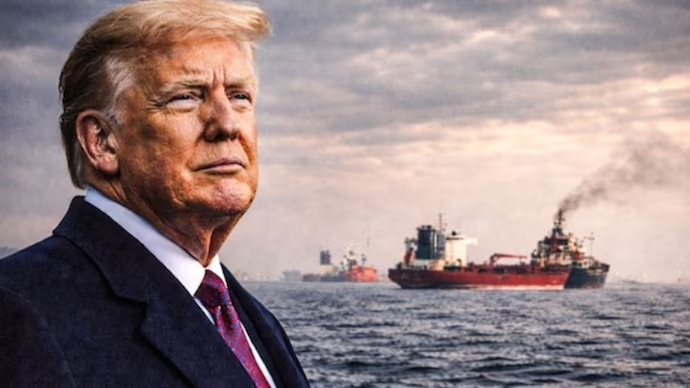
As efforts to revive talks over the Iran conflict continue to falter, US President Donald Trump has escalated tensions with an unusually sharp warning directed at Oman, a long-time American ally in the Gulf.
During a tense Cabinet meeting on May 28, Trump declared that no country would be allowed to control the Strait of Hormuz, not even Oman, after reports claimed Muscat and Tehran were discussing a framework to jointly oversee shipping traffic through the strategic waterway.

“Nobody’s going to control it,” Trump said. “It’s international waters and Oman will behave just like everybody else or we’ll have to blow them up.”
The remarks triggered widespread surprise in diplomatic circles, given Oman’s longstanding role as one of Washington’s closest regional partners. The Gulf nation has hosted US military cooperation programmes for decades and frequently served as a quiet mediator between the United States and Iran during periods of heightened tension.
The Strait of Hormuz has become a central issue in negotiations aimed at ending the ongoing US-Israel conflict with Iran. Before the war erupted earlier this year, nearly 20% of the world’s oil and liquefied natural gas shipments passed through the narrow maritime corridor daily, making it one of the world’s most critical energy routes.
White House dismisses Iran-Oman shipping proposal
Earlier on May 28, Iranian state television reported that an unofficial draft agreement under discussion could restore commercial shipping through Hormuz to pre-war levels within a month.
According to the report, Iran and Oman would jointly supervise shipping traffic through the strait. The proposed memorandum of understanding also reportedly included a reduction in US military presence around Iran and an end to the American naval blockade.
The White House, however, swiftly rejected the report, calling it a “complete fabrication”.
Trump later reiterated that the waterway would remain open under international maritime access rules.
“We’ll watch over it, but nobody’s going to control it,” he said.
Trump ties Iran deal to Abraham Accords expansion
The US President also intensified pressure on Gulf and Muslim-majority nations to formally join the Abraham Accords, the diplomatic agreements brokered during his first term that normalized ties between Israel and several Arab countries, including the United Arab Emirates and Bahrain.
Trump said countries such as Saudi Arabia, Qatar, Pakistan, Turkey, Egypt and Jordan should now join the framework officially.
“I think they owe that to us, to be honest,” Trump said, adding that envoys Steve Witkoff and Jared Kushner were actively involved in the negotiations.
In a further sign that talks with Tehran remain fragile, Trump suggested future progress with Iran could depend on whether more countries sign the accords.
“I’m not sure we should make the deal if they don’t sign,” he said.
Nuclear deadlock continues
Beyond the Strait of Hormuz dispute, Iran’s nuclear programme remains another major sticking point in negotiations.
The Iranian television report made no mention of dismantling Tehran’s nuclear activities, despite continued US demands for strict curbs on Iran’s nuclear programme.
According to Reuters, Iranian officials want nuclear issues to be discussed only in a second phase of negotiations.
US Secretary of State Marco Rubio rejected any suggestion of compromise.
“The bottom line is Iran’s never going to have a nuclear weapon,” Rubio said during the Cabinet meeting.
Trump has repeatedly demanded that Iran surrender its highly enriched uranium stockpile and has ruled out sanctions relief in exchange for handing over uranium material.
War pressure builds ahead of US midterms
The ongoing conflict is also creating political pressure for Trump at home. Recent opinion polls indicate the war remains unpopular among American voters, particularly as fuel and energy prices continue to rise.
Despite growing domestic concerns, Trump signalled no intention of softening his position.
“I don’t care about the midterms,” he said.
The remarks come less than six months before crucial midterm elections that could determine whether Republicans retain control of the US Congress.

IIIT Ranchi student death: NHRC to examine allegations of administrative negligence and delayed medical aid
.jpg&w=256&q=75)
Karnataka introduces 7.5% sub-quota for rural government school students in professional course admissions
Dubai forum to examine AI agents’ role in journalism and digital publishing

NEET PG Counselling 2026 Round 1 registration begins Oct 12, check schedule and key dates
Groundwater and urban resilience in focus at UAEU’s international conference
IIIT Ranchi student death: NHRC to examine allegations of administrative negligence and delayed medical aid
Karnataka introduces 7.5% sub-quota for rural government school students in professional course admissions
Dubai forum to examine AI agents’ role in journalism and digital publishing
NEET PG Counselling 2026 Round 1 registration begins Oct 12, check schedule and key dates
PM Modi praises NEP impact, Tamil Nadu CM Vijay seeks ₹5,110 crore in dues

IIIT Ranchi student death: NHRC to examine allegations of administrative negligence and delayed medical aid
Karnataka introduces 7.5% sub-quota for rural government school students in professional course admissions
Dubai forum to examine AI agents’ role in journalism and digital publishing
NEET PG Counselling 2026 Round 1 registration begins Oct 12, check schedule and key dates
Groundwater and urban resilience in focus at UAEU’s international conference
IIIT Ranchi student death: NHRC to examine allegations of administrative negligence and delayed medical aid
Karnataka introduces 7.5% sub-quota for rural government school students in professional course admissions
Dubai forum to examine AI agents’ role in journalism and digital publishing
NEET PG Counselling 2026 Round 1 registration begins Oct 12, check schedule and key dates
PM Modi praises NEP impact, Tamil Nadu CM Vijay seeks ₹5,110 crore in dues
Copyright© educationpost.in 2026 All Rights Reserved.