


Abdul Rahim’s release ends a two-decade ordeal marked by tragedy, a death sentence, and one of Kerala’s biggest crowdfunding campaigns.
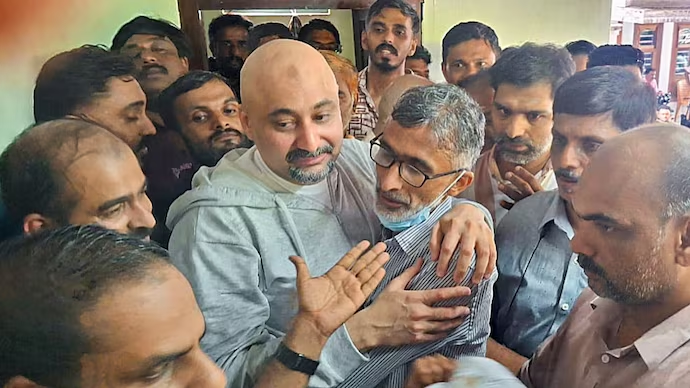
After spending nearly 20 years on death row in a Saudi Arabian prison, Abdul Rahim returned to his hometown in Kerala on Eid, bringing an emotional end to a case that had gripped the state for years.
The native of Kodampuzha in Ramanattukara near Kozhikode arrived at Karipur International Airport from Riyadh in the early hours of May 28 and was reunited with his family at their ancestral home in Machilakathu.

His return came days after Saudi authorities released him following the payment of ₹34.35 crore in blood money, raised through a massive crowdfunding campaign backed largely by the global Malayali community.
Rahim, a driver by profession, had travelled to Saudi Arabia on November 28, 2006, in search of better employment opportunities. Before leaving Kerala, he worked as a school bus and autorickshaw driver.
Less than a month after arriving in Riyadh, he was assigned to assist Anas Al Shahri, the 17-year-old son of his sponsor, Fayis Abdullah Abdulrahman Al Shahri. The teenager was paralysed and depended on a breathing support system.
According to reports, tragedy struck on December 24, 2006, when Rahim accidentally touched a medical support device attached to the boy while driving. Anas later lost consciousness and died.
Saudi authorities arrested Rahim the same day, just 28 days after he had entered the country. Following years of legal proceedings, a Saudi court sentenced him to death in 2011. The verdict was subsequently upheld by higher courts.
A breakthrough came in 2024 when the victim's family agreed to pardon Rahim in exchange for diyah, or blood money, amounting to 15 million Saudi riyals, roughly ₹34.35 crore.
Under Islamic law, diyah is financial compensation paid to the victim or the victim's heirs in cases involving death, bodily harm or property damage that is not intentional. The practice forms part of legal systems in countries including Saudi Arabia, Iran, Pakistan and the United Arab Emirates.
After the settlement, a Saudi court revoked Rahim's death sentence on July 2, 2024. However, authorities directed him to complete his 20-year prison term, which concluded on May 20 under the Arabic calendar.
Rahim's release was made possible by an extraordinary fundraising effort that united Malayalis across the world.
When his family was unable to arrange the compensation amount, community organisations in Saudi Arabia and support groups in Kerala launched the "Save Abdul Rahim" campaign. What began as an appeal for help soon evolved into one of the largest public crowdfunding drives in Kerala's recent history.
Contributions poured in from expatriates, workers and well-wishers across the globe. Between late March and April 12, 2024, donations exceeded ₹47.87 crore through a dedicated mobile application.
More than 60 Malayali organisations in Saudi Arabia coordinated legal assistance and advocacy for nearly two decades, while committees in Kerala spearheaded fundraising and awareness campaigns.
In an official statement issued on May 28, the Embassy of India in Riyadh said Abdul Rahim had been pardoned and released after two decades in prison on May 20. The embassy noted that his flight to India had departed shortly before the statement was released.
The mission also said it had consistently pursued the case with Saudi authorities and regularly monitored Rahim's welfare throughout his incarceration.
Rahim's return home was marked by tears, relief and celebration. Fighting back emotion, he thanked those who stood by him throughout the ordeal.
"I thank all Keralites across the world, who made my release a reality," he said after arriving home.
The years in prison took a heavy toll on his family. His father, Muhammedkutty, died six months after his arrest. His mother, Fathima, was able to meet him in person only once, in November 2024 after his pardon. For much of his imprisonment, their contact was limited to occasional video calls.
His homecoming on Eid became a moment of collective joy for the family, supporters and the wider community that spent years campaigning for his freedom.
The Embassy of India in Riyadh also extended its wishes to Rahim and his family as they began a new chapter together after two decades of separation.

IIIT Ranchi student death: NHRC to examine allegations of administrative negligence and delayed medical aid
.jpg&w=256&q=75)
Karnataka introduces 7.5% sub-quota for rural government school students in professional course admissions

Dubai forum to examine AI agents’ role in journalism and digital publishing

NEET PG Counselling 2026 Round 1 registration begins Oct 12, check schedule and key dates
Groundwater and urban resilience in focus at UAEU’s international conference
IIIT Ranchi student death: NHRC to examine allegations of administrative negligence and delayed medical aid
Karnataka introduces 7.5% sub-quota for rural government school students in professional course admissions
Dubai forum to examine AI agents’ role in journalism and digital publishing
NEET PG Counselling 2026 Round 1 registration begins Oct 12, check schedule and key dates
PM Modi praises NEP impact, Tamil Nadu CM Vijay seeks ₹5,110 crore in dues

IIIT Ranchi student death: NHRC to examine allegations of administrative negligence and delayed medical aid
Karnataka introduces 7.5% sub-quota for rural government school students in professional course admissions
Dubai forum to examine AI agents’ role in journalism and digital publishing
NEET PG Counselling 2026 Round 1 registration begins Oct 12, check schedule and key dates
Groundwater and urban resilience in focus at UAEU’s international conference
IIIT Ranchi student death: NHRC to examine allegations of administrative negligence and delayed medical aid
Karnataka introduces 7.5% sub-quota for rural government school students in professional course admissions
Dubai forum to examine AI agents’ role in journalism and digital publishing
NEET PG Counselling 2026 Round 1 registration begins Oct 12, check schedule and key dates
PM Modi praises NEP impact, Tamil Nadu CM Vijay seeks ₹5,110 crore in dues
Copyright© educationpost.in 2026 All Rights Reserved.