


Tehran says attacks are retaliation for US action on Qeshm Island; Kuwait intercepts incoming missiles as Bahrain sounds warning sirens.
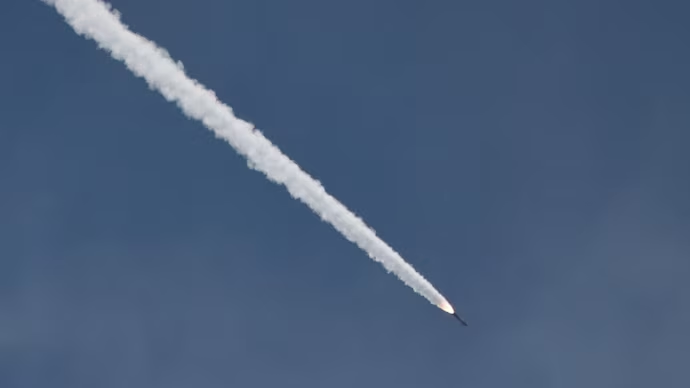
Iran launched missile and drone attacks targeting US military facilities in Kuwait and Bahrain on June 3, describing the operation as retaliation for a US strike on Iran's Qeshm Island and warning that any further aggression would invite a harsher response.
Iran's Armed Forces said they targeted the US Fifth Fleet and a US air base in the region after what they alleged were US attacks on an Iranian telecommunications antenna and an oil tanker. The military said the strikes were part of a response it had previously warned would be "different and more severe".

The attacks triggered air defense responses across the Gulf. Kuwait's military said its air defence systems intercepted hostile missiles and drones early on June 3 after residents reported hearing loud explosions across parts of the country.
As tensions escalated, Kuwait's Ministry of Defense issued a public warning urging citizens and residents not to approach debris, shrapnel or unidentified objects that may have fallen during interception operations. Authorities said such remnants could pose serious safety risks.
In a statement, the ministry's official spokesperson, Colonel Saud Abdulaziz Al-Otaibi, asked the public to immediately report suspicious objects through the emergency hotline 112 or relevant authorities. Residents were also urged to rely only on official sources of information and follow security advisories.
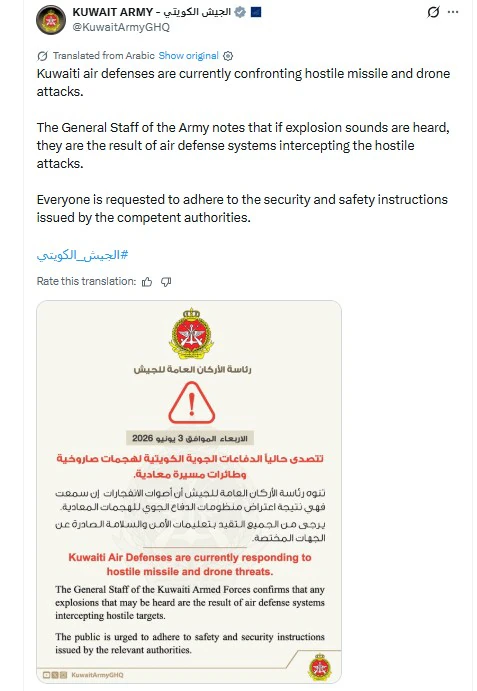
"The General Staff of the Army calls on everyone to cooperate and adhere to the issued guidelines to preserve the security and safety of all," the statement said.
The latest developments come amid rising tensions between the United States and Iran following a series of military exchanges across the region.
Iran's state broadcaster, IRIB, claimed that American bases in Kuwait were targeted in response to what it called "hostile actions" by the US in the Persian Gulf, the Strait of Hormuz and on Qeshm Island. The broadcaster said US military facilities in Kuwait had been struck, though there was no independent confirmation of the claim.
Bahrain's Interior Ministry said warning sirens were activated on June 3 and urged citizens and residents to remain calm, move to the nearest safe location and follow official safety instructions.
IRIB also shared footage on X that it claimed showed Iranian missiles crossing the skies over Bahrain.
According to IRIB, the Iranian military said it had targeted the US Fifth Fleet and a US air base in retaliation for what it described as a US attack on a telecommunications antenna and an Iranian oil tanker.
"Following the US attack on a telecommunications antenna and an Iranian oil tanker, we targeted the United States Fifth Fleet and a US air base in the region," the military said.
It added that Tehran had already warned that any aggression would be met with a stronger response.
"We had previously warned that in the event of aggression, the response would be different and more severe, and tonight we acted on our word," the statement said.
The latest escalation follows a US strike on Qeshm Island on June 2. The United States said it targeted an Iranian military ground control station allegedly used to direct drone operations.
According to the US Central Command (CENTCOM), the operation came after American forces intercepted multiple Iranian drones and ballistic missiles launched across the Middle East.
CENTCOM later issued a clarification rejecting Iranian claims that US military bases in the region had suffered successful attacks.
The exchange marks one of the most serious confrontations between the two countries in recent months and is likely to deepen security concerns across the Gulf region.

Madurai Kamaraj University seeks grants for college struggling to pay salaries amid ₹2 crore annual deficit

IISc Study Challenges Chandrasekhar Limit, Finds White Dwarfs Could Grow Far Beyond Expected Mass

Surat medical college ragging case: Two senior doctors arrested after PG student’s death

IIIT Ranchi student death: NHRC to examine allegations of administrative negligence and delayed medical aid
.jpg&w=256&q=75)
Karnataka introduces 7.5% sub-quota for rural government school students in professional course admissions
Madurai Kamaraj University seeks grants for college struggling to pay salaries amid ₹2 crore annual deficit
IISc Study Challenges Chandrasekhar Limit, Finds White Dwarfs Could Grow Far Beyond Expected Mass
Surat medical college ragging case: Two senior doctors arrested after PG student’s death
IIIT Ranchi student death: NHRC to examine allegations of administrative negligence and delayed medical aid
Karnataka introduces 7.5% sub-quota for rural government school students in professional course admissions

Madurai Kamaraj University seeks grants for college struggling to pay salaries amid ₹2 crore annual deficit
IISc Study Challenges Chandrasekhar Limit, Finds White Dwarfs Could Grow Far Beyond Expected Mass
Surat medical college ragging case: Two senior doctors arrested after PG student’s death
IIIT Ranchi student death: NHRC to examine allegations of administrative negligence and delayed medical aid
Karnataka introduces 7.5% sub-quota for rural government school students in professional course admissions
Madurai Kamaraj University seeks grants for college struggling to pay salaries amid ₹2 crore annual deficit
IISc Study Challenges Chandrasekhar Limit, Finds White Dwarfs Could Grow Far Beyond Expected Mass
Surat medical college ragging case: Two senior doctors arrested after PG student’s death
IIIT Ranchi student death: NHRC to examine allegations of administrative negligence and delayed medical aid
Karnataka introduces 7.5% sub-quota for rural government school students in professional course admissions
Copyright© educationpost.in 2026 All Rights Reserved.