


Fresh strikes near the Strait of Hormuz push tensions higher as Tehran accuses Washington of violating the ceasefire and threatening regional stability.
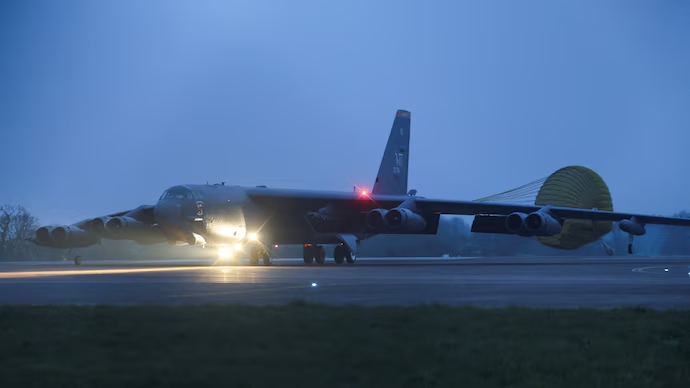
Iran’s Islamic Revolutionary Guard Corps (IRGC) said on May 28 that it targeted a US airbase after what Tehran described as an American attack near Bandar Abbas airport earlier in the day. The strike was carried out at around 4:50 am local time, according to Iranian media reports, which did not disclose the location of the US base.
In a strongly worded statement, the IRGC warned that any further action by Washington would be met with a “more decisive” response.

The escalation came hours after US officials confirmed military action against Iranian drone operations near the Strait of Hormuz, a critical global energy corridor.
According to Reuters, US forces shot down four Iranian attack drones that officials believed posed a threat to American troops and commercial shipping in the region. The US military also struck a drone ground-control station near Bandar Abbas that was allegedly preparing to launch another drone.
American officials described the operation as limited and defensive, saying it was aimed at preserving the ceasefire that came into effect in early April.
Tehran, however, accused Washington of repeatedly violating the truce. Iranian state-linked media claimed the IRGC Navy fired warning shots at a US-linked oil tanker attempting to pass through the Strait of Hormuz, forcing it to retreat.
Another report said four vessels trying to transit the waterway without Iranian coordination were also turned back after warnings from Iranian naval forces.
The Strait of Hormuz remains at the heart of the conflict. Before the war erupted in February, the narrow maritime route handled nearly 20% of global oil and liquefied natural gas shipments.
Iranian state media said only 23 vessels crossed the strait with Iranian permission in the previous 24 hours, sharply lower than normal traffic levels before the conflict began.
Renewed military activity pushed global oil prices higher after steep declines earlier in the week. US crude futures rose nearly 2% in Asian trading amid fears of disruption to energy supplies.
US President Donald Trump further heightened tensions by rejecting reports of a possible framework agreement under which Iran and Oman would jointly oversee commercial shipping through the Strait of Hormuz.
Speaking during a cabinet meeting, Trump said no country would control the waterway and warned Oman against attempting to dominate regional shipping routes. The White House later dismissed Iranian media reports about a draft agreement as fabricated.
Washington also unveiled new sanctions targeting the Persian Gulf Strait Authority, a newly formed Iranian body responsible for managing shipping passage requests through the strait.
Negotiations aimed at ending the three-month conflict remain stalled over major disagreements, including Iran’s uranium enrichment programme, sanctions relief and control over Hormuz.
Iran has maintained that its nuclear programme is intended for peaceful purposes and insists it will not abandon it. US officials continue to say Tehran must never be allowed to develop nuclear weapons.
Trump has also attempted to widen diplomatic efforts by urging countries including Saudi Arabia, Qatar, Egypt, Pakistan and Turkey to join the Abraham Accords and normalize ties with Israel. However, several nations are reportedly resisting the proposal.
Despite repeated signals from Washington that a broader agreement could still be reached, the latest military exchanges underline how far apart the two sides remain.

IIIT Ranchi student death: NHRC to examine allegations of administrative negligence and delayed medical aid
.jpg&w=256&q=75)
Karnataka introduces 7.5% sub-quota for rural government school students in professional course admissions

Dubai forum to examine AI agents’ role in journalism and digital publishing

NEET PG Counselling 2026 Round 1 registration begins Oct 12, check schedule and key dates
Groundwater and urban resilience in focus at UAEU’s international conference
IIIT Ranchi student death: NHRC to examine allegations of administrative negligence and delayed medical aid
Karnataka introduces 7.5% sub-quota for rural government school students in professional course admissions
Dubai forum to examine AI agents’ role in journalism and digital publishing
NEET PG Counselling 2026 Round 1 registration begins Oct 12, check schedule and key dates
PM Modi praises NEP impact, Tamil Nadu CM Vijay seeks ₹5,110 crore in dues

IIIT Ranchi student death: NHRC to examine allegations of administrative negligence and delayed medical aid
Karnataka introduces 7.5% sub-quota for rural government school students in professional course admissions
Dubai forum to examine AI agents’ role in journalism and digital publishing
NEET PG Counselling 2026 Round 1 registration begins Oct 12, check schedule and key dates
Groundwater and urban resilience in focus at UAEU’s international conference
IIIT Ranchi student death: NHRC to examine allegations of administrative negligence and delayed medical aid
Karnataka introduces 7.5% sub-quota for rural government school students in professional course admissions
Dubai forum to examine AI agents’ role in journalism and digital publishing
NEET PG Counselling 2026 Round 1 registration begins Oct 12, check schedule and key dates
PM Modi praises NEP impact, Tamil Nadu CM Vijay seeks ₹5,110 crore in dues
Copyright© educationpost.in 2026 All Rights Reserved.