At least 40 people, including civilians and soldiers, were killed in US airstrikes on Caracas early January 3, Venezuelan officials said, as American Special Operations forces carried out a dramatic night-time raid that led to the capture of President Nicolás Maduro and his wife.
The strikes, described by a senior Venezuelan official as among the deadliest attacks on the capital in years, came as helicopters ferried US troops into Maduro’s compound after a large-scale aerial assault intended to cripple Venezuela’s air defenses. The official, speaking to The New York Times on condition of anonymity, said early reports indicated heavy casualties across multiple locations.

President Donald Trump confirmed the operation in a television interview, saying no US troops were killed, though some may have been injured. General Dan Caine said helicopters extracting Maduro came under fire, with one aircraft hit but still able to fly.
Civilian toll in low-income neighborhoods
The deadliest damage was reported in Catia La Mar, a low-income area near Caracas airport, where an airstrike tore through a three-storey residential building, collapsing an exterior wall and sending debris across the street.
Among those killed was 80-year-old Rosa González, her family told the Times. Her nephew, Wilman González, said the explosion occurred around 2 a.m. as residents slept. Four local men attempted to rush her to hospital on a motorbike, but she was declared dead on arrival. Another woman survived the blast but remains in critical condition.
Residents gathered quietly outside the shattered building on Saturday morning. Some prayed; others voiced anger and disbelief. “I lost everything,” said Jorge, a 70-year-old neighbour. Another resident, Javier, blamed what he described as greed linked to Venezuela’s oil wealth.
How the raid unfolded
According to US officials, more than 150 American aircraft were deployed to neutralise Venezuelan air defences before helicopters delivered troops to Maduro’s residence. The raid began shortly after 2 a.m. local time and lasted roughly two hours and 20 minutes.
Maduro and his wife were then flown out of the country and taken to New York City, where they are expected to face federal drug charges under a new indictment.
Despite the capture, competing claims to authority quickly emerged. In a national address broadcast on state television, Vice President Delcy Rodríguez insisted Maduro remained the country’s legitimate leader. “There is only one president in this country, and his name is Nicolás Maduro Moros,” she said.
Opposition leader María Corina Machado, meanwhile, called for Edmundo González to be recognised as president, declaring the opposition ready “to enforce our mandate and take power.”
President Trump said Secretary of State Marco Rubio had spoken with Rodríguez and suggested she was open to cooperation with Washington. He dismissed Machado as lacking sufficient support to lead the country.
Washington’s justification
US officials said the intervention was driven by long-standing criminal cases against Maduro and senior figures in his government. A federal court in New York has charged Maduro, his wife and four others with offences including narco-terrorism and cocaine conspiracy, echoing an earlier 2020 indictment.
At a news conference, Trump said the United States would effectively oversee Venezuela until a “safe, proper and judicious transition” was established. He also spoke openly about opening Venezuela’s state-controlled oil sector to US companies. “We are going to run the country right. It’s going to make a lot of money,” he said.
Anger, protests and uncertainty
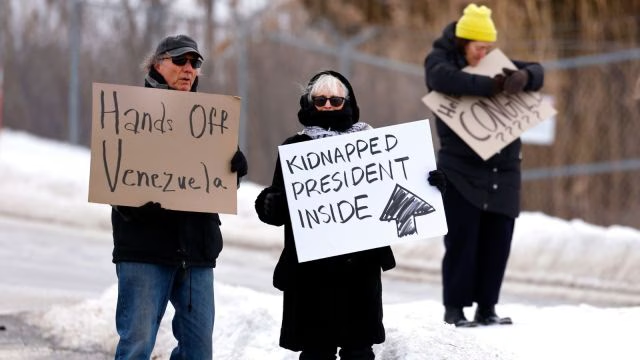
Inside Venezuela, state-run television showed anti-US protests in several cities, including Caracas, where Maduro supporters denounced the raid as illegal and described his transfer as kidnapping. The Times reported that the operation was aided by a CIA source inside the Venezuelan government who had tracked Maduro’s movements.
In the days leading up to the strike, the US military had built up troops, ships and aircraft in the Caribbean and disrupted vessels and tankers linked to Venezuela, further squeezing the country’s oil revenues.
By Saturday afternoon, there were no clear signs of a full-scale US military occupation, and Maduro-aligned officials continued to appear in government roles. With Rodríguez and the opposition both pressing rival claims to power, and Washington insisting it will manage a transition, Venezuela now faces a volatile and uncertain chapter.