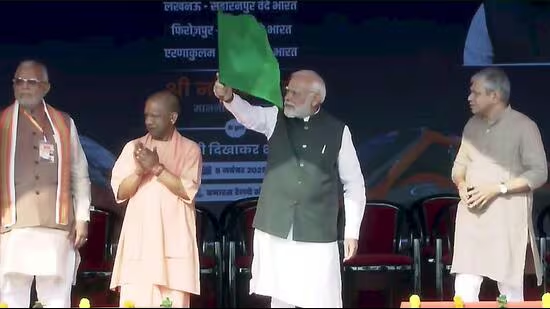
Prime Minister Narendra Modi on November 8 flagged off four new Vande Bharat Express services, expanding the semi-high-speed network to more than 160 operational trains nationwide.
The new routes connect Varanasi to Khajuraho, Lucknow to Saharanpur, Firozpur to Delhi, and Ernakulam to Bengaluru—linking key cultural, economic, and tech corridors across India.

Addressing a gathering in Varanasi, Modi called Vande Bharat trains “a matter of pride for every Indian,” asserting that next-generation services such as Vande Bharat, Namo Bharat, and Amrit Bharat are “laying the foundation for the future of Indian Railways.” Railway Minister Ashwini Vaishnaw and senior members of the Railway Board were present.
Modi said the new services will significantly cut travel time, improve regional mobility, and deepen tourism flows—particularly along heritage and pilgrimage circuits that have seen surging demand.
The four new Vande Bharat routes
Banaras–Khajuraho
The new service will reduce travel time by nearly 2 hours and 40 minutes and provide faster access to religious destinations such as Varanasi, Prayagraj and Chitrakoot, as well as the UNESCO-listed Khajuraho temples.
Tourism Welfare Association president Rahul Mehta said the route will trigger a “manifold rise” in domestic and foreign tourist movement between the Varanasi–Khajuraho circuit. Khajuraho, which saw around 500,000 domestic tourists in 2024, is projected to receive 1.5–2 million visitors in 2025.
Lucknow–Saharanpur
At 7 hours and 45 minutes, this service saves nearly an hour on the route, benefiting passengers across Sitapur, Shahjahanpur, Bareilly, Moradabad, Bijnor, Saharanpur and Haridwar.
Firozpur–Delhi
Completing the journey in 6 hours and 40 minutes, it becomes the fastest train on the route. It strengthens connectivity between the national capital and Punjab’s key urban centres, including Firozpur, Bathinda and Patiala.
Ernakulam–Bengaluru
Cutting more than two hours off existing travel times, the train will cover the inter-state journey in 8 hours and 40 minutes. It is expected to boost economic links and mobility across Kerala, Tamil Nadu and Karnataka — connecting major IT hubs, commercial centres, students and tourists.
Modi highlights infrastructure push in Uttar Pradesh
Modi said sustained development efforts in Uttar Pradesh over the past 11 years have transformed pilgrimage-led travel. Varanasi alone recorded 11 crore pilgrim visits last year, while the newly inaugurated Ram Temple in Ayodhya has drawn more than 6 crore visitors.
He said this surge has fuelled a wider economic ripple: strengthening incomes for hotels, transport operators, traders, artisans and boatmen. “Hundreds of youth in Varanasi are launching new ventures—from transport services to Banarasi sari enterprises,” he noted.
PM also highlighted ongoing improvements in hospitals, roads, gas pipelines, internet networks and urban infrastructure. Work on the Varanasi ropeway is accelerating, and new sports facilities such as the Ganjari and Sigra stadiums have taken shape.
On healthcare, he recalled a time when BHU was the only option for tertiary treatment, forcing many to travel outside the state—often at high financial cost. He said new institutions, including the Mahamana Cancer Hospital, Shankar Netralaya, the advanced trauma centre and Centenary Hospital at BHU, and the divisional hospital at Pandeypur, now serve Varanasi, Purvanchal and neighbouring states.
Due to Ayushman Bharat and Jan Aushadhi Kendras, he added, lakhs of poor patients are saving crores annually on medical care.



.jpg&w=256&q=75)



.jfif&w=256&q=75)