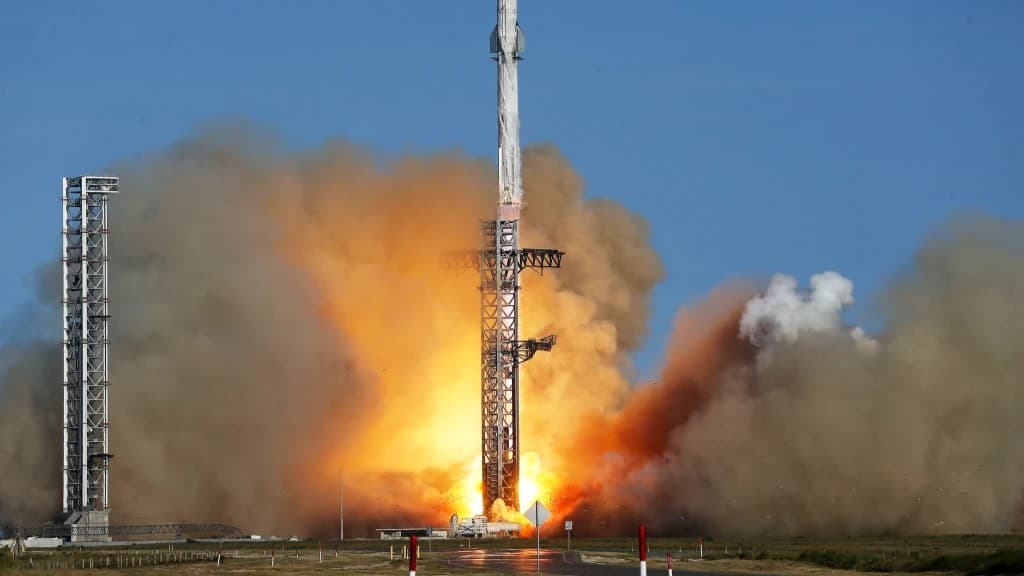
SpaceX’s Starship rocket soared into space from Texas on May 27 in its ninth uncrewed test flight, marking significant progress despite falling short of a complete mission.
The launch surpassed the duration of the last two failed attempts, demonstrating key advancements in Elon Musk’s pursuit of interplanetary travel.

The two-stage vehicle, featuring the Starship spacecraft mounted atop the massive Super Heavy booster, lifted off from SpaceX’s Starbase facility near Brownsville, Texas, at around 7:36 pm EDT.
The launch was streamed live, showing the rocket erupting from the pad in a blaze of fire and thick clouds of exhaust as the Raptor engines ignited.
This test marked the first time SpaceX used a previously flown Super Heavy booster with the Starship system, aiming to further validate the reusability of the rocket's components.
Shortly after liftoff, the booster successfully separated from the upper-stage Starship and began its descent.
However, SpaceX lost communication with the booster during its return, and it is believed to have plunged into the sea instead of achieving the planned controlled splashdown.
Meanwhile, the upper-stage Starship continued on its path, reaching the targeted suborbital trajectory about nine minutes into flight.
However, a malfunction occurred when the spacecraft's payload doors failed to open to release simulated satellites, a key objective of the test.
SpaceX intended to end the flight, which was scheduled to last under 90 minutes, with a controlled descent and splashdown in the Indian Ocean.
But roughly 30 minutes into the mission, the company reported a loss of attitude control, causing the spacecraft to spin uncontrollably as it approached atmospheric re-entry.
"We will not be aligned as we wanted it to be aligned for re-entry," a SpaceX commentator said during the webcast. "Our chances of making it all the way down are pretty slim."
Despite the setbacks, the test demonstrated crucial progress for SpaceX's Starship system, which is central to future missions aimed at the Moon, Mars, and beyond.