‘Like a baby learning to walk’: Astronaut Shubhanshu Shukla’s heartfelt space call captures India’s leap to the stars
In his first live message from orbit, IAF pilot-turned-astronaut calls the experience “indescribable,” and celebrates India’s return to human spaceflight after 41 years.
EPN Desk26 June 2025 06:58
From 418 kilometers above Earth, came a voice filled with awe and purpose — that of Indian astronaut Shubhanshu Shukla, calling in live from space, with a “Namaskar” that resonated far beyond the static of the void.
In his first communication after June 25 historic launch aboard the Axiom Space mission, Shukla compared his early moments in zero gravity to a child learning to walk. “It’s like being a baby again — figuring out how to move, how to control yourself,” said the IAF Group Captain, laughing mid-sentence. “But I’m really enjoying every moment.”
Floating aboard the Crew Dragon spacecraft as it journeys toward the International Space Station (ISS), Shukla’s tone was equal parts science and soul. “Seeing the Indian tricolour up here… it reminded me that I’m not alone. All of you are with me on this journey,” he said.
He called the mission “a strong step forward for India’s human space program,” and a foundational push toward the upcoming Gaganyaan mission — India’s indigenous crewed spaceflight project. “It’s not just about technical ambition,” he stressed. “It’s about the spirit and purpose behind the entire journey. I want each one of you to feel like you’re part of this mission.”
While the scientific objectives remain rigorous, Shukla didn’t shy away from sharing the lighter side of space life. “Honestly, I’ve been sleeping a lot,” he chuckled, visibly adapting to life in microgravity.
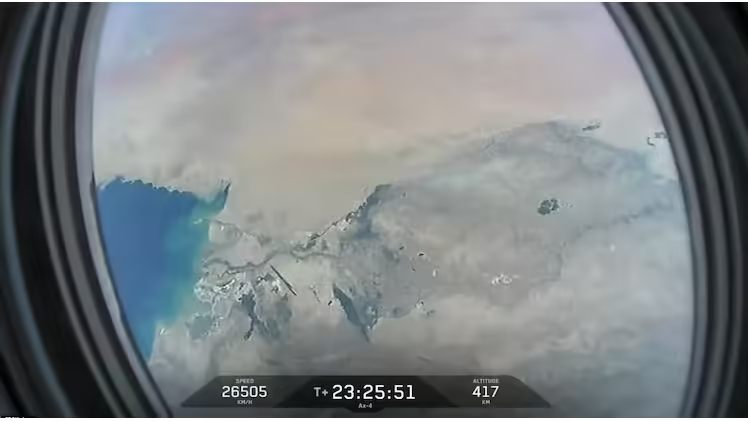
From the spacecraft window, he described the view of Earth as nothing short of “beautiful,” sharing a glimpse of the fragile blue planet from hundreds of kilometers above.
Shukla’s journey marks India’s return to human spaceflight after a 41-year gap — the last being Rakesh Sharma’s legendary mission in 1984. This mission, launched aboard Elon Musk’s SpaceX Falcon-9 rocket from Kennedy Space Center in Florida, carries a four-member international crew: Commander Peggy Whitson (USA), Shukla as mission pilot, and specialists Tibor Kapu (Hungary) and Slawosz Uznanski-Wisniewski (Poland).
After multiple weather delays, liftoff occurred at 12:01 pm IST on June 26 — a moment watched by millions back home. For India, it was more than a launch; it was a symbol of resurgence, readiness, and resolve in the global space arena.
“Over the next 14 days, I will complete key tasks and document this experience — not just for the mission, but for every Indian who dreams of the stars,” Shukla said, signing off with a promise as powerful as the liftoff that carried him skyward.