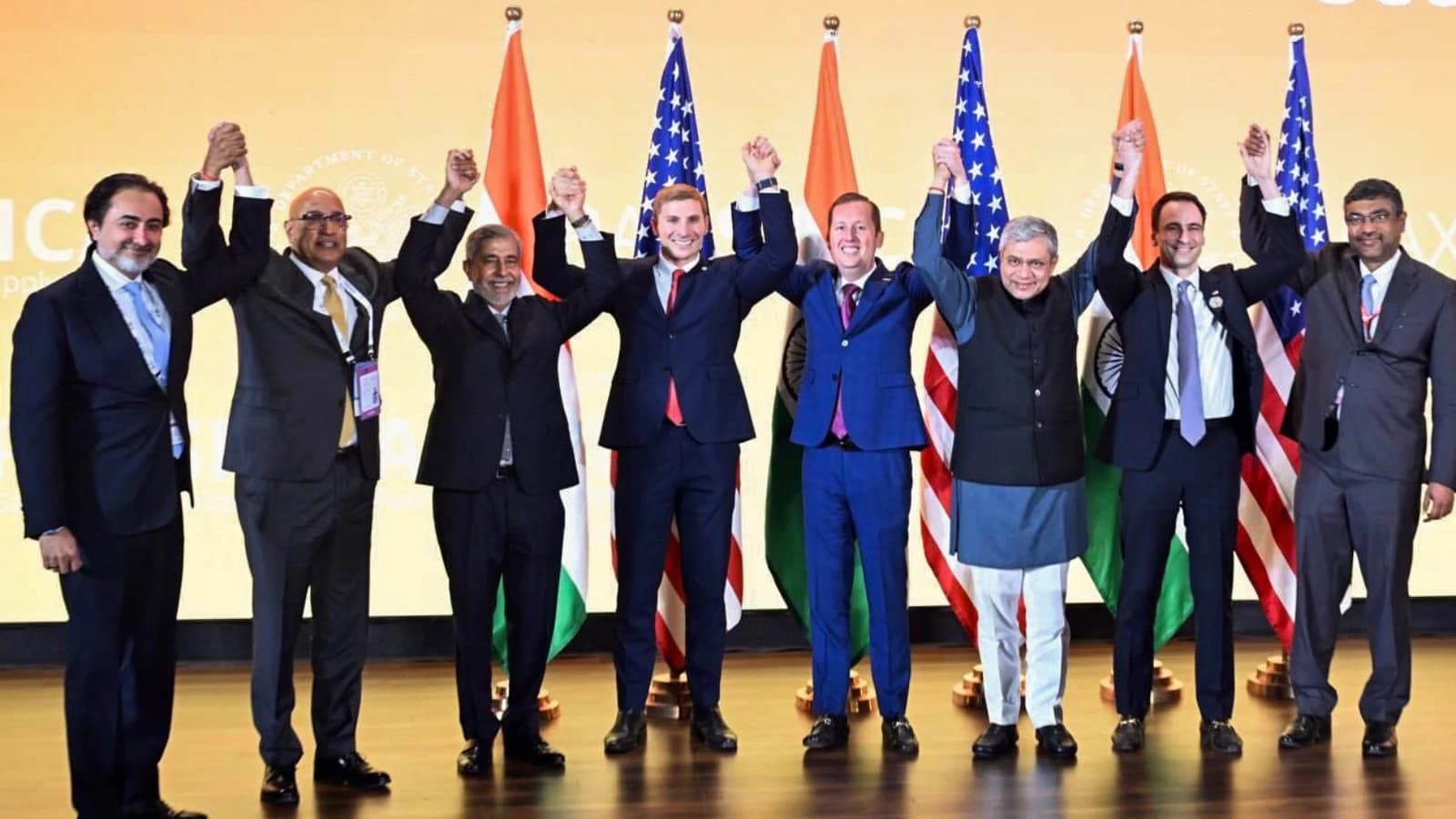
In a significant strategic shift, India on February 20 formally joined Pax Silica, a US-led initiative aimed at securing artificial intelligence and critical technology supply chains — a move Washington described as a major boost to the coalition’s strength and credibility.
The development signals a clear thaw in India-US ties after months of friction triggered by tariff measures under the Donald Trump administration. US Ambassador Sergio Gor said Secretary of State Marco Rubio will visit India “very soon, in a matter of months”, underlining renewed diplomatic momentum.

Gor also indicated that a long-awaited India-US trade deal is close to being finalised, reinforcing signs of deepening economic engagement.
Quad at the centre
Emphasizing Washington’s strategic priorities, Gor said Rubio’s first diplomatic engagement after assuming office was with the Quadrilateral Security Dialogue — comprising India, the US, Japan and Australia.
“The Quad is very important,” Gor said, calling it a message to the world that the grouping remains central to US Indo-Pacific strategy. Rubio’s upcoming India visit is expected to include Quad consultations alongside broader bilateral initiatives.
On the possibility of a Trump visit, Gor confirmed that Prime Minister Narendra Modi had extended an invitation. While no dates have been announced, he said the former president “loved his visit to India” and is likely to return.
Strategic signal to China
The Pax Silica agreement was signed at the AI Impact Summit in the presence of Union IT Minister Ashwini Vaishnaw, senior Indian officials and US representatives including Under Secretary for Economic Affairs Jacob Helberg and White House science advisor Michael Kratsios.
Welcoming India into the coalition, Helberg warned of “massively over-concentrated” supply chains for critical minerals and the risks of “economic coercion and blackmail” — remarks widely interpreted as a veiled reference to China’s restrictions on rare earth magnet exports, vital for industries ranging from aviation to consumer electronics.
The Ministry of External Affairs confirmed that India signed the Pax Silica Declaration and a bilateral addendum titled the “India-US AI Opportunity Partnership”.
Beyond government deals
Helberg clarified that Pax Silica is designed not merely as a government-to-government arrangement but as a platform enabling private-sector collaboration in advanced manufacturing, semiconductors, AI infrastructure and critical minerals.
“It’s not just a G2G platform,” he said, stressing that industry partnerships would be central to building resilient supply chains.
Gor framed India’s entry as strategically consequential. “Peace comes through strength,” he said, adding that India’s emphasis on sovereignty and secure borders aligns with the coalition’s vision. “Strength multiplies when it’s connected.”
Securing the AI era
Launched on December 12, 2025, Pax Silica seeks to reduce “coercive dependencies” and create secure, innovation-driven supply chains spanning critical minerals, energy inputs, semiconductors, advanced computing and AI infrastructure. The initiative is widely seen as a coordinated effort to counter China’s dominance in global manufacturing ecosystems.
India’s accession not only strengthens the coalition’s geopolitical weight but positions New Delhi as a central player in shaping the technological architecture of the AI age — deepening its Comprehensive Global Strategic Partnership with Washington while recalibrating global supply chain power equations.