Researchers in Germany have successfully revived key functions in frozen brain tissue, demonstrating that complex neural activity can return after exposure to extremely low temperatures.
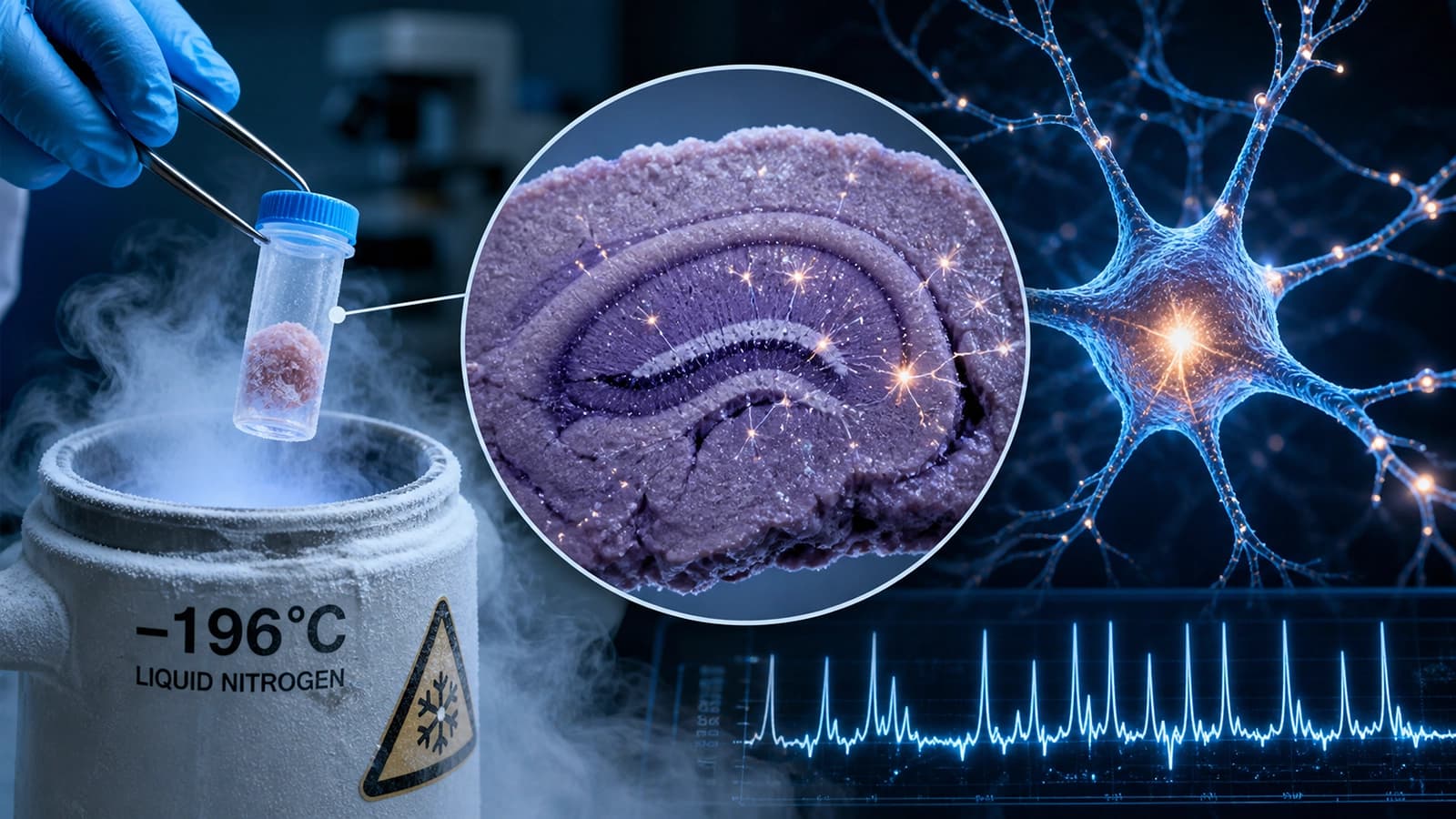
The study, conducted at Friedrich-Alexander-Universität Erlangen-Nürnberg and University Hospital Erlangen, focused on preserving slices of adult mouse hippocampal tissue. Scientists used a technique known as vitrification to cool the tissue to approximately −196°C, the temperature of liquid nitrogen, before carefully rewarming it.

Vitrification prevents the formation of ice crystals, which typically damage cells during freezing. Instead, the tissue enters a glass-like state, preserving its structure. After thawing, the samples showed intact cellular architecture, and neurons resumed electrical activity.
Researchers observed that signals were able to travel across neural networks, indicating restored synaptic communication. Notably, the tissue also demonstrated long-term potentiation, a process closely linked to learning and memory, suggesting that core brain functions remained viable.
The hippocampus, the brain region examined in the study, plays a crucial role in memory formation and information processing. By targeting this area, scientists were able to assess whether fundamental mechanisms of cognition could survive extreme preservation. The findings suggest that, under controlled laboratory conditions, certain brain functions can endure deep freezing.
However, researchers cautioned against broader interpretations. The experiment involved thin slices of brain tissue, not entire brains or living organisms. It does not demonstrate the possibility of freezing and reviving a whole brain, nor does it preserve consciousness, identity, or full memory systems. Concepts such as human cryosleep or suspended animation remain speculative and far from current scientific capability.
Despite these limitations, the work represents a significant advance in cryobiology. The ability to preserve both structure and function in delicate brain tissue could have applications in organ preservation, neurological studies, and drug testing. It may also improve long-term storage of biological samples for research.
The study highlights that while reviving frozen humans is not on the horizon, preserving and restoring activity in complex tissues is becoming increasingly feasible, opening new avenues in biomedical science.