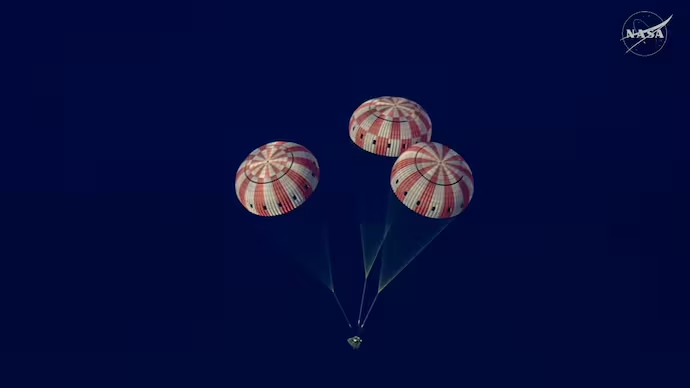
In a landmark moment for modern space exploration, NASA’s Artemis II mission has successfully splashed down in the Pacific Ocean, marking the triumphant end of humanity’s first crewed journey to the Moon in the 21st century.
The daring expedition carried four astronauts a record 4,06,778 km from Earth—farther than any human has ever travelled—before returning through a fiery re-entry into the planet’s atmosphere. As parachutes deployed above the ocean, the Orion spacecraft completed a flawless descent, bringing the crew safely home after a tense and historic voyage.

Widely regarded as a defining milestone, Artemis II is the first mission since the Apollo program to send humans into the Moon’s vicinity, signaling a major leap toward sustained exploration beyond low-Earth orbit.
A fiery return to Earth
The crew—Commander Reid Wiseman, Pilot Victor Glover, and Mission Specialists Christina Koch and Jeremy Hansen—travelled aboard the Orion spacecraft, enduring extreme conditions during re-entry.
Hurtling at speeds exceeding 40,000 kmph, the capsule withstood searing temperatures before deploying parachutes for a controlled splashdown. Recovery teams quickly secured the spacecraft, greeting the astronauts as they emerged smiling after a high-stakes 10-day journey around the Moon and back.
A critical step toward future landings
Unlike Artemis I, which tested systems without a crew, Artemis II validated life-support systems, navigation, and deep-space operations with astronauts onboard during a complex lunar flyby.
The mission also delivered striking images of the Moon and Earth, echoing iconic visuals from earlier eras while showcasing next-generation capabilities. Crucially, it generated vital data that will shape upcoming missions, including Artemis III, which aims to return humans to the lunar surface for the first time in over five decades.
With Artemis II’s success, a new chapter in human spaceflight has begun—one that not only revives lunar exploration but sets the stage for future journeys to Mars and beyond.