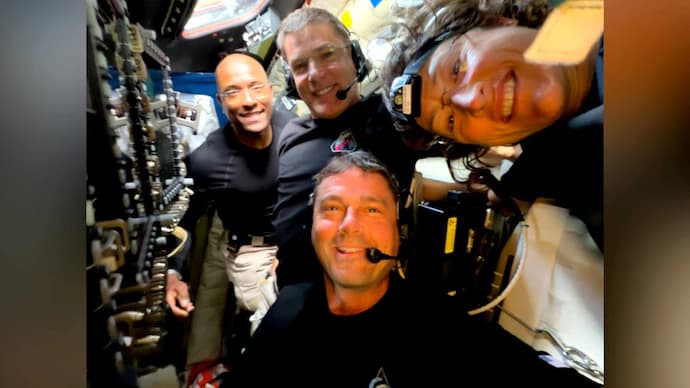
The crew of Artemis II has begun its long journey back to Earth, marking a critical phase in humanity’s return to deep space exploration after a historic mission around the Moon.
At 10:55 pm IST on April 7, the Orion spacecraft successfully exited the Moon’s sphere of influence — the region where lunar gravity dominates the spacecraft’s motion. Having used the Moon’s gravity as a powerful slingshot to accelerate, the four astronauts are now firmly under Earth’s gravitational pull, speeding homeward.

Three-day transit and precision manoeuvres
With the Moon now behind them, the crew has entered a crucial three-day transit phase focused on preparing for reentry into Earth’s atmosphere.
During this period, astronauts will carry out a series of trajectory correction burns — precise, short engine firings designed to align the spacecraft perfectly with its reentry corridor. The margin for error remains razor-thin: a shallow angle could cause the capsule to skip off the atmosphere, while a steep descent risks exposing it to extreme and potentially dangerous heat.
Reentry at 40,000 km/h and extreme heat
The most intense phase of the mission will unfold on April 10, when Orion reenters Earth’s atmosphere at a blistering speed of 40,000 kilometres per hour.
To withstand temperatures reaching 2,760°C, the spacecraft will deploy a “skip reentry” technique — briefly dipping into the atmosphere to slow down, exiting momentarily, and then reentering for a controlled descent. This approach reduces stress on the crew while improving landing accuracy.
Splashdown off San Diego coast
The mission is scheduled to conclude with a splashdown in the Pacific Ocean off the coast of San Diego at approximately 5:37 am IST on April 11.
A recovery operation led by the USS John P. Murtha is already in position. Following parachute deployment and water landing, divers will secure the capsule and assist the astronauts aboard the recovery vessel.
The successful splashdown will mark the completion of the first crewed mission to the Moon’s vicinity in more than five decades, signalling a major milestone in the next era of human space exploration.