


Tharoor, Sharma, Tewari and Kamal Nath back government’s “mature” handling, undercut party’s attack line on foreign policy and fuel supply concerns.
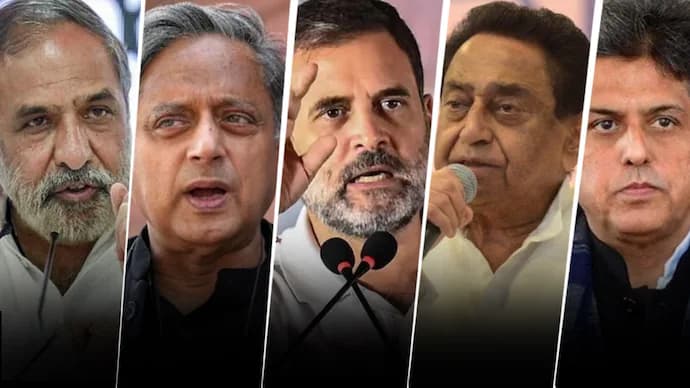
A visible rift has emerged within the Congress, with several senior leaders breaking ranks with Rahul Gandhi over the party’s stance on the Iran conflict and the domestic LPG supply situation. While Gandhi has sharpened his attack on the Narendra Modi government, leaders such as Kamal Nath, Anand Sharma, Shashi Tharoor and Manish Tewari have publicly endorsed the Centre’s handling of the crisis.
The divergence comes amid the ongoing West Asia tensions and concerns over LPG supply, exposing fault lines within the party’s top leadership. Gandhi, Leader of Opposition in the Lok Sabha, has repeatedly criticized the government’s diplomatic posture in the US-Israel-Iran conflict, describing India’s foreign policy under Narendra Modi as “compromised”.

However, Tharoor offered a sharply contrasting view, terming the government’s approach “responsible statecraft”, while Tewari indicated that the Centre was “likely doing the right thing” in managing the volatile situation.
Senior Congress figures have not only distanced themselves from the party’s official line but also praised the government’s response. Sharma commended India’s diplomatic handling of the crisis as “mature and skillful” and stressed the need for national consensus in navigating what he described as an “unpredictable and volatile situation”.
Kamal Nath, meanwhile, rejected the party’s claims of an LPG shortage, asserting that “there is no such shortage” and accusing certain quarters of creating a false atmosphere of scarcity for political purposes.
The remarks provided ammunition to the BJP, with Jyotiraditya Scindia accusing the Congress of spreading fear and misinformation, and party spokesperson Pradeep Bhandari launching a sharp attack on Gandhi.
This is not the first instance of internal discord within the Congress under Gandhi’s leadership. A similar divide surfaced following Operation Sindoor in May 2025, when India carried out strikes on terror infrastructure in Pakistan after the Pahalgam attack that killed 26 tourists in Jammu and Kashmir.
At the time, Tharoor and Tewari backed the government and praised the armed forces, even as Gandhi questioned the Centre’s “political will”. The disagreement had tangible consequences, with both leaders reportedly sidelined during the parliamentary debate on the operation.
The Modi government had also formed an all-party delegation of 59 parliamentarians to present India’s position globally, with Tharoor leading one of the groups—an appointment that drew objections from the Congress leadership.
The ongoing West Asia conflict has once again exposed divisions within the Congress. While Gandhi has continued to criticize the government and urged a stronger stance, including condemnation linked to Iran’s leadership, senior party figures have emphasized restraint, diplomacy and national unity.
Sharma highlighted India’s historical ties with Persia alongside present-day energy concerns, underscoring the need for a balanced and strategic response. Kamal Nath, on the domestic front, reiterated that there was no shortage of cooking gas in Madhya Pradesh, countering the party’s broader narrative.
The contrasting positions underline a deeper ideological and strategic split within the Congress—between a combative opposition line led by Gandhi and a more measured approach advocated by sections of its senior leadership on issues of foreign policy and national interest.
The revival of student-union elections at Indian universities: Explained

El Niño raises food-production risks as WMO flags uneven rainfall outlook for South Asia

EU research groups seek greater say in €175 billion Horizon Europe programme

NSF opens bioengineering funding call with awards of up to $50 million a year

A whale’s death inspired him at four, now 11-year-old is set for Earth Medal
A whale’s death inspired him at four, now 11-year-old is set for Earth Medal
Prof. Ajay Kumar Sood named International Science Council Fellow for 2026
2.6 million Afghan girls have lost five years of education, says UNICEF

Riyadh, Diriyah extend remote learning as security concerns persist
.jpg&w=256&q=75)
From Class 8 to hospital owner: Rajasthan Police expose alleged fake doctor registration

The revival of student-union elections at Indian universities: Explained
El Niño raises food-production risks as WMO flags uneven rainfall outlook for South Asia
EU research groups seek greater say in €175 billion Horizon Europe programme
NSF opens bioengineering funding call with awards of up to $50 million a year
A whale’s death inspired him at four, now 11-year-old is set for Earth Medal
A whale’s death inspired him at four, now 11-year-old is set for Earth Medal
Prof. Ajay Kumar Sood named International Science Council Fellow for 2026
2.6 million Afghan girls have lost five years of education, says UNICEF
Riyadh, Diriyah extend remote learning as security concerns persist
From Class 8 to hospital owner: Rajasthan Police expose alleged fake doctor registration
Copyright© educationpost.in 2026 All Rights Reserved.