The Supreme Court has constituted a high-powered expert committee to re-examine the definition and delineation of the Aravalli hill range, directing the panel to submit a comprehensive report by August 31, 2026.
The move comes months after the court stayed the implementation of an October 2025 report prepared by a committee headed by the Secretary of the Ministry of Environment, Forest and Climate Change (MoEFCC).

The court had raised concerns over ambiguities in the report and stressed the need for an independent scientific assessment of the ecologically sensitive mountain range.
The newly constituted committee will be headed by Kanchan Devi, Director General of the Indian Council of Forestry Research and Education (ICFRE). Other members include former Forest Survey of India Director General Subhash Ashutosh, former Geological Survey of India Director Rajendra Kumar Sharma, former Environment Ministry Joint Secretary Brij Mohan Singh Rathore and former Delhi University Botany Department head Ashok K. Bhatnagar.
The court has also named Professor Jagdish Krishnaswamy of the Indian Institute for Human Settlements and Professor Laxmikant Sharma of the Central University of Haryana as special invitees who may assist the panel when required. The Environment Ministry has been directed to nominate an officer of Director rank to serve as the committee's Member Secretary.
At the heart of the dispute is the definition adopted in November 2025, which classified an Aravalli hill as a landform rising at least 100 metres above local relief and defined an Aravalli range as two or more such hills located within 500 metres of each other.
Environmental groups and experts argued that the criteria could exclude large stretches of the ancient mountain system from protection, potentially making them vulnerable to mining and development activities.
The Supreme Court has asked the panel to examine whether limiting the definition to hills meeting the 100-metre threshold and the 500-metre distance criterion significantly reduces the area eligible for environmental safeguards.
The committee will also assess whether hills separated by larger distances can still function as part of a continuous ecological system and whether mining should be permitted in such areas.
Another issue before the panel is the finding in the 2025 report that only 1,048 of Rajasthan's 12,081 hills satisfy the 100-metre elevation benchmark.
The committee has been asked to evaluate the scientific basis of this conclusion and determine whether lower-elevation formations also require protection.
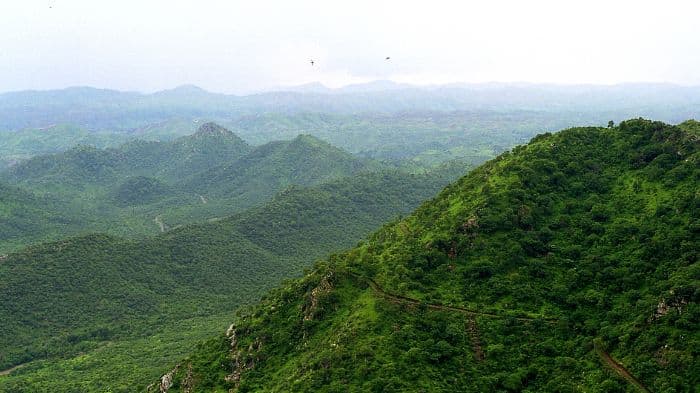
The Aravalli range, one of the world's oldest mountain systems, stretches across Delhi, Haryana, Rajasthan and Gujarat. Environmentalists have long described it as a critical ecological barrier that helps check desertification, supports biodiversity and aids groundwater recharge in northwestern India.
The matter is being heard in a suo motu case concerning the definition and protection of the Aravalli hills. The Supreme Court is expected to consider the panel's findings after the report is submitted later this year.