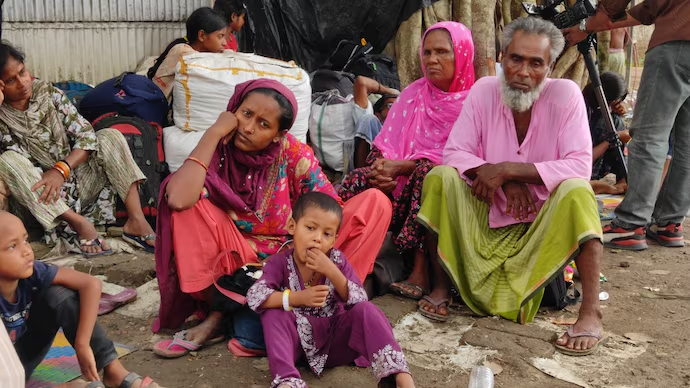
Fearing detention amid an intensified crackdown in West Bengal, hundreds of illegal Bangladeshi migrants are now gathering near border points and transit terminals, uncertain about whether they will be able to cross back home.
Many of them, some of whom have spent decades in India and built entire lives here, are now openly describing how they entered the country illegally and secured identity documents after arrival.

Their accounts paint a troubling picture of organized cross-border networks involving middlemen, forged documentation and alleged local political support systems that helped migrants blend into Indian society over the years.
Some recalled crossing rivers under the cover of darkness. Others spoke of dalals, or middlemen, who monitored Border Security Force (BSF) patrol movements and coordinated crossings whenever surveillance weakened.
One migrant said entering India could take “just 10 minutes” if handlers found a “gap” in patrolling.
Others claimed they later obtained Aadhaar cards, voter IDs and ration cards through local contacts. Some admitted receiving benefits under welfare schemes and even participating in elections.
The disclosures come as authorities tighten action against illegal immigration in West Bengal. Chief Minister Suvendu Adhikari has said illegal Bangladeshi migrants should be handed directly to the BSF instead of being sheltered or produced before courts. The BJP government has also intensified efforts to identify and remove ineligible beneficiaries from welfare schemes.
Border districts across Bengal have witnessed heightened checks and monitoring in recent weeks. Reports have also emerged of migrants voluntarily attempting to return to Bangladesh to avoid detention centres or deportation proceedings.
On May 28, Union Home Minister Amit Shah said that since many infiltrators were “returning on their own”, the government would not initiate legal action against them. He also praised Suvendu Adhikari for facilitating the transfer of 600 hectares of land to the BSF, including areas near the strategic Chicken Neck corridor.
‘The moment they find a gap, they send people across’
One of the most striking aspects of the testimonies is the alleged sophistication of the border-crossing operations.
A carpenter from Bangladesh’s Kushtia district said he paid ₹7,000-8,000 to a middleman who tracked BSF movement at night before moving groups across the border.
Speaking to local YouTube channel Haldia Live, another illegal Bangladeshi migrant described how the network operated.
“They have teams of five to six people. At night, they check which areas have BSF presence and which do not. The moment they find a gap, they send people across,” he said.
He added that migrants sometimes had to wait the entire night for an opportunity to cross safely. Another migrant in Bengaluru claimed he entered India despite “military presence at the border” after paying ₹20,000 to an agent.
“An Aadhaar card was arranged for ₹2,000-3,000. We later travelled to Bengaluru by train,” he said.
India’s 4,096-km border with Bangladesh includes riverine stretches, agricultural fields and densely populated settlements, making monitoring difficult in several sectors. Security agencies have repeatedly warned about trafficking and smuggling syndicates exploiting these vulnerabilities to facilitate illegal crossings.
On May 28, Meghalaya Chief Minister Conrad Sangma said fencing work along the Indo-Bangladesh border in the state was nearing completion, with only 40-45 km remaining.
Earlier, in February 2025, the Ministry of Home Affairs stated that nearly 79% of the India-Bangladesh border had already been fenced, covering over 3,232 km.
‘I got my voter card and ration card made in India’
Several migrants also alleged that local political workers helped them obtain documents after they entered India.
One woman claimed workers associated with the Trinamool Congress assisted her in securing identity papers.
“I got my voter card and ration card made when Mamata’s party was in power. Party people helped me get the documents. I also received Lakshmir Bhandar benefits for two to three years,” she said.
Another migrant said the atmosphere changed dramatically after the recent crackdown.
“No one said anything during Trinamool Congress rule. Now people are after us. Even landlords are scared because they fear a ₹2 lakh fine and two years in jail if they keep Bangladeshi tenants,” he said.
The man also admitted that he had voted once in India and claimed his wife received cash transfers under the Lakshmir Bhandar scheme.
On May 28, Suvendu Adhikari alleged that nearly 30 lakh ineligible beneficiaries, including non-Indians, had been receiving benefits under the Lakshmir Bhandar scheme. He said such beneficiaries had now been identified and excluded from the upcoming Annapurna Bhandar scheme.
Years spent in India, now preparing to leave
Many migrants waiting near border crossings said they had spent years working in India as carpenters, masons and domestic workers before deciding to leave.
Salam Dali, standing near the Hakimpur border with his wife and child was quoted as saying that he had worked as a carpenter after entering India around five years ago.
The Khulna resident said he paid ₹8,000-10,000 to a middleman for the crossing. Another migrant was quoted as saying that he had arrived in India as a child with his parents.
“My parents brought me here when I was very young. Father worked as a carpenter. No one questioned us. We just lived and worked,” he said.
Similar accounts were reported from migrants gathered near border terminals.
Among them was Taklima Khatun from Bangladesh’s Khulna district, who said she entered India through the Ghojadanga border two years ago to work as a domestic help.
According to the report, she decided to return voluntarily out of fear of detention centres and forced deportation.
Another migrant, Shahidul Gazi from Satkhira, said he crossed into India three years ago through the Swarupnagar border with the help of a middleman.
Many admitted that the absence of valid Indian citizenship documents ultimately left them with little choice but to return.
The testimonies collectively point to what appears to be a deeply organised ecosystem involving middlemen, forged documents and cross-state support networks. Beyond the political battle surrounding illegal immigration, the admissions have also reignited concerns over border security, welfare leakages and the burden placed on India’s administrative and financial systems.





.png&w=256&q=75)