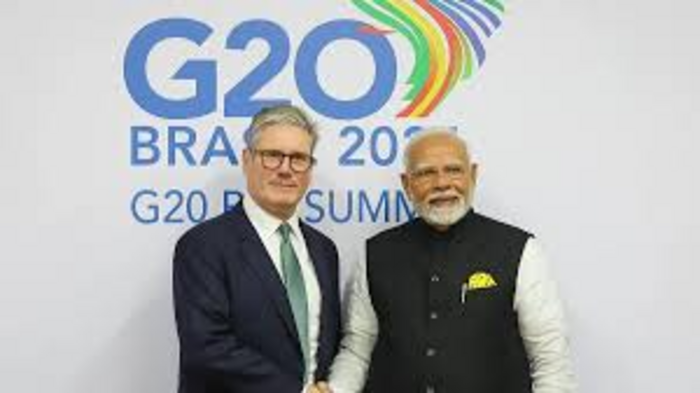
India and the United Kingdom have concluded negotiations on a Comprehensive Economic Partnership Agreement (CEPA), marking a major milestone in bilateral economic relations. The agreement covers a wide range of areas, including trade in goods and services, intellectual property rights (IPR), digital trade, investment facilitation, and regulatory cooperation.
Under the CEPA, both countries are expected to reduce or eliminate tariffs on a significant number of goods, enhancing market access for key sectors such as textiles, pharmaceuticals, automobiles, and agricultural products. The agreement also aims to simplify customs procedures and improve standards harmonization to ease cross-border trade.

In the services sector, the CEPA provides enhanced opportunities for IT professionals, financial services, education, and legal services, facilitating mobility of skilled professionals and promoting mutual recognition of qualifications. This is particularly significant for India, given its competitive advantage in knowledge-based industries.
The agreement includes provisions on intellectual property protection and digital trade, ensuring stronger safeguards for innovation while promoting data-driven commerce. Rules on e-commerce, cross-border data flows, and digital payments are expected to enhance cooperation in emerging technology sectors.
Investment facilitation mechanisms, dispute resolution frameworks, and commitments to transparent regulatory practices form an integral part of the CEPA. The agreement also aligns with broader strategic objectives, including supply chain diversification and post-Brexit economic engagement for the UK.
Beyond economics, the CEPA strengthens strategic and geopolitical ties, reinforcing cooperation in areas such as defence, climate action, education, and innovation.
Significance
The India–UK CEPA is expected to boost bilateral trade, attract foreign investment, and create employment opportunities. By deepening economic integration and strategic collaboration, the agreement strengthens long-term bilateral ties and enhances India’s position in global trade networks.