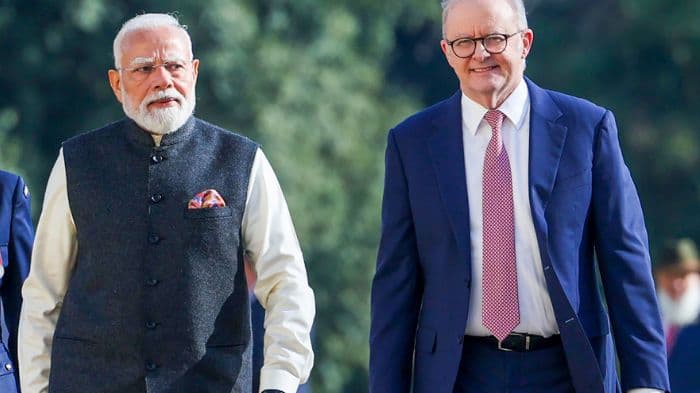
India and Australia on July 9 finalised the administrative arrangements required to enable the export of Australian uranium to India for exclusively peaceful purposes, with Prime Minister Narendra Modi saying the landmark agreement would strengthen India's clean energy ambitions and further deepen bilateral cooperation in the energy sector.
Announcing the development during a joint press meet with his Australian counterpart Anthony Albanese after the Annual Leaders' Summit here, PM Modi said the two countries had reached an important agreement in the field of nuclear energy.

"Today, we have reached an important agreement in the field of nuclear energy. This will open the path for uranium supply from Australia to India and give new strength to our clean energy objectives," PM Modi said.
The announcement came as the two countries issued a Joint Statement on Energy Security, reaffirming their commitment to strengthening cooperation in energy trade, supply chain resilience and the transition to cleaner sources of energy.
According to the joint statement, Australia and India have finalised the administrative arrangements necessary to enable the export of Australian uranium to India under the Australia-India Nuclear Cooperation Agreement (2015).
The uranium exports will be exclusively for peaceful purposes and subject to safeguards of the International Atomic Energy Agency (IAEA).
In addition, the two countries expressed concern over the situation in West Asia and its impact on global energy supply chains and commodity prices, reaffirming their commitment to open markets and rules-based trade.
Recognising Australia's role as a key supplier of liquefied natural gas to India and India's role as an important supplier of liquid fuels and downstream petroleum products to Australia, the two sides committed to maintaining uninterrupted energy flows and enhancing bilateral energy trade and investment.
Moreover, India and Australia also pledged to strengthen the resilience of energy supply chains by deepening regional cooperation, accelerating the energy transition, promoting renewable energy and low-carbon fuels, and encouraging greater investment across the energy value chain.
The joint statement also reaffirmed both countries' commitment to maintaining a stable, secure and reliable supply of energy products, including coal, diesel, natural gas and other liquid fuels. Australia also acknowledged India's Global Biofuels Alliance initiative as part of efforts to accelerate the global energy transition.
Highlighting the broader strategic partnership, PM Modi said India and Australia, as vibrant democracies and important Indo-Pacific partners, shared a common vision and deep mutual trust.
"India and Australia are two vibrant democracies, two multicultural societies and two important ocean powers. These similarities, and our common worldview, inspire us to keep moving forward with deep mutual trust," he said.
“Except for the headline, no changes have been made to the story by Education Post staff.”