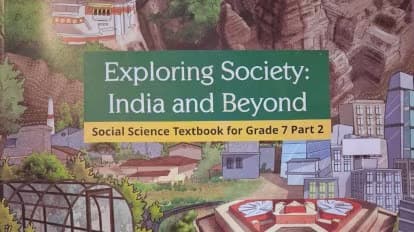
India’s newly issued Class 7 NCERT Social Science textbooks introduce a sharper focus on regional diplomacy and medieval history, with expanded material on relations with neighboring countries and significantly revised content on early invasions of the subcontinent.
Released last week, the second volume of the textbook, “Exploring Society: India and Beyond,” includes a new chapter titled “India and Her Neighbors.” The chapter outlines India’s complex ties with Pakistan, China and Afghanistan.

It states that “frequent terrorist attacks launched against India with the support of the Pakistan army have prevented normal relations between the two countries.”
It adds that conflicts since Partition, including the wars of 1948, 1965, 1971, and the Kargil conflict in 1999, continue to shape bilateral ties.
On China, the book highlights “heightened tensions” in recent years linked to border disputes, while noting ongoing efforts to manage differences through trade, dialogue, and established mechanisms. It also points out that Afghanistan once shared a direct land border with India.
The revised textbooks replace the earlier three-book structure of history, geography, and social and political life with two consolidated volumes under the updated curriculum.
A major change in the new edition is the detailed expansion of the section on Mahmud of Ghazni.
The earlier single paragraph has grown into six pages, with accounts of his campaigns in Mathura, Kannauj, and the Somnath temple, supported by illustrations.
A prefatory note titled “A Word of Caution" reminds students that studying violent periods of history is necessary for understanding long-term developments, while emphasizing that no one today bears responsibility for actions taken centuries ago.
The book describes the brutality of Mahmud’s invasions, including large-scale killings, enslavement of civilians, and the destruction of temples.
It notes that Mahmud targeted Hindus, Buddhists, Jains, and rival Islamic groups, citing accounts by chroniclers such as Al-Utbi and Al-Biruni.
Al-Biruni’s description of the destruction of the Somnath Shivalinga and its removal to Ghazni is included, along with a reference to the temple’s reconstruction in 1950 under President Rajendra Prasad.
Expanding the historical narrative further, the chapter “Turning Tides: 11th and 12th Centuries” discusses Muhammad Ghuri, Qutb-ud-din Aibak, and Bakhtiyar Khilji, highlighting Khilji’s destruction of Nalanda and Vikramashila and the resulting decline of Buddhism in eastern India. These details did not appear in the previous Class 7 edition.
The chapter places these invasions within a wider timeline beginning in the 6th century, covering rulers of Kashmir, Kannauj, the Chalukyas, Rashtrakutas, Pallavas, and Cholas.

It also discusses earlier invasions by the Hunas and Arabs, including Muhammad bin Qasim’s campaign in Sindh and the relatively limited long-term political and religious impact of his conquest.
NCERT Director Dinesh Saklani said the revised content is intended to provide a clear and comprehensive understanding of India’s historical developments.
The new textbooks align with the National Education Policy 2020 and the National Curriculum Framework 2023, forming part of a broader effort to update school learning materials for the current academic session.